Wednesday, April 08, 2015

struggling against God

… his defenses against religious belief were going to crumble. And at about this time they started crumbling quickly. … the unbelief he had always thought his protection was in fact his prison.

I don’t think of myself as having defenses against religious belief. I haven’t built great walls, erected desperate barriers, locked doors, or armed myself against faith. Rather, faith puzzles and intrigues me. I wonder about it and look into it. Because I don’t get it.

I’ve heard this formulation before, that the unbeliever rejects God, struggles against the Lord’s intrusion into his life, fights not to believe. The easier thing would be relax and surrender. God will just come right in and take over.

This has not been my experience. Nothing about Christianity makes sense to me. I have to struggle to figure out what it’s trying to tell me. “Sin” is a piece of Christian jargon that doesn’t make any sense. An infant is born out of sin. It is sinful in the womb. Murder is also a sin. As is thinking. What, then, is “sin”? And that’s about as basic a piece of the Christian puzzle as exists. If sin is baffling, how am I supposed to get to God embodying himself as a mortal, then sacrificing himself to himself in order to absolve other mortals from sin?

C. S. Lewis, from Surprised by Joy:
You must picture me … feeling … the steady, unrelenting approach of Him Who I so earnestly desired not to meet. … I gave in and admitted that God was God, and knelt and prayed … the most dejected and reluctant convert in all England … kicking, struggling, resentful, and darting … eyes in every direction for a chance of escape.

The quote at the top of the post is from Alan Jacobs’ biography of C. S. Lewis. A couple pages later Jacobs quotes Lewis himself on the struggle to ward off God. The writing is certainly vivid. The “kicking, struggling, resentful, and darting” body evokes a toddler in full-on temper tantrum. But what is it the toddler wants? What does keeping out this god do for him? Conversely, what does allowing this god in do for him? Well, I guess it allows him to stop struggling. Struggling is a lot of work; knocking that off would be a relief.

For me, all the struggling would be the other way. Every time I’ve tried to wrap my mind around the Christian equation it’s been a struggle. It’s a whole lot easier just to shrug my shoulders and say, “It seems to work for them. That’s nice. So long as it’s not hurting anybody. There are even some who say Jesus motivates them to do good in the world. I like good. People doing good is a good thing.” People do terrible things in the name of Jesus, too.

source: The Narnian: the life and imagination of C. S. Lewis by Alan Jacobs

Tuesday, April 07, 2015

Cambodia notes

I picked up Walter Mason’s Destination Cambodia in the library a couple weeks ago. I’ve been enjoying Mason’s stories. The title may be generic but the writing has personality.

When we were in Cambodia last November Kent and I did not take buses (the tour company’s hired coach doesn’t count), but the bus we took down the Mexico’s Baja peninsula a few years ago had loud movies playing so I could identify with this:

The bus driver played DVDs of Korean pop music for the whole five-hour drive, probably because there was hardly anyone on the bus and no-one seemed to care. In truth, he actually played only two DVDs of Korean pop, the same two, over and over again, obviously favourites of the young conductor who would often reach over to repeat Big Bang’s “Fantastic Baby.”

I looked up Big Bang’s “Fantastic Baby.” The boy band wears freaky costumes and I love the deadpan reading of that refrain: “Wow. Fantastic baby.”


***

So “Fantastic Baby” is Korean not Cambodian. We did a layover in Inchon on our way to Southeast Asia. That counts, doesn’t it?

On the other hand I’m now on the lookout for something else mentioned in Destination Cambodia:

Suong Mak was the author of a … novel that was thought to be the first ever in Khmer to talk about gay male relationships.

Mason recounts a delightful story about Suong Mak as a teen writing his first fiction (a ghost story) and his mother’s help in finding a publisher. Seemingly the search ends in disappointment. Two years later, having moved to the big city to attend university, Mak comes across his story in a bookstore. Not only did it get turned into a book, the publisher is happy to have Mak show up to ask about it and hand him over money, as the book is doing well.

I looked up Suong Mak. He has a blog, which is very much in Cambodian. Google Translate currently does a terrible job with Cambodian. Too bad. If it’s true the novel is “being translated into English,” I want a copy when it’s ready. I like the title: Boyfriend

source: Destination Cambodia: adventures in the kingdom by Walter Mason

Monday, April 06, 2015

Make Your Own Emily Dickinson Poem

The vastest earthly Day
Is shrunken small
By one Defaulting Face
Behind a Pall —

… [Emily] Dickinson often offered several choices for certain words in her poems: the “vastest earthly Day” might be “shrunken” small, but it might also be “shriveled” or “dwindled.” More provocatively, it might be “chastened.” … Dickinson [also] wonder[s] if the face should not be “defaulting” but “heroic” …

The vastest earthly Day
Is chastened small
By one heroic Face
That owned it all —

In the quote above James Longenbach first presents an Emily Dickinson poem in, presumably, the default version. Then he does what Dickinson must have done many times, if only in her head; Longenbach gives us the same (?) Dickinson poem using alternate words Dickinson herself provided in manuscript. The two versions read as different poems to me.

When I decided to read her the version of Emily Dickinson I committed to was The Complete Poems edited by Thomas H. Johnson. I had heard that in manuscript Dickinson poems will sometimes include alternate words scrawled next to the ones supposedly preferred (actually it is not clear sometimes that one word is preferred). But I figured I had to read Dickinson in some version and the edition most readily available was the one Johnson created, deciding for us the definitive version of every Dickinson poem. I figured if I fell in love I could pursue every scrap of Dickinson, but if love didn’t strike right away, well, I’d at least have a Dickinson as good as any.

Which makes me think. Might there be an easier way to find the Dickinson that’s right for you? One could create a computer program in which different Dickinsons are available, every one authentic. Click on a word and see it switch to an alternate. Maybe the Emily Dickinson you yourself make out of true Dickinson ingredients is the Emily Dickinson that speaks to you.

source: The Virtues of Poetry by James Longenbach

Wednesday, April 01, 2015

pile of reading

MOJO Music Magazine #254, January 2015
The local library has a subscription. If the CD that comes with the magazine hasn’t been lifted I like to give it a listen. The CD this time features what the MOJO editors consider some of the best new music of 2014. I’m listening to the CD right now. My favorites so far are “Turn it Up” by Robert Plant, “Keep It in the Dark” by Temples, and “Milly’s Garden” by Steve Gunn. I like the lyrics of “Turtles All the Way Down” by Sturgill Simpson, but the very country twang puts me off. Worth another listen, I guess. Now I will move on to reading articles.

Proving Nothing to Anyone by Matt Cook
This is my fourth Matt Cook in a row. At some point I picked up his first book of poems, In the Small of My Backyard. Must not have been terribly long ago, but I don’t remember the circumstances. So I got around to reading it — and was delighted! I enjoyed Cook’s second and third books and here I am one poem into Proving Nothing to Anyone.

Poetry July/August 2014, v.204 no.4
I’m working my way through the 2014 issues of Poetry. Worth the time.

Some Angels Wear Black: selected poems by Eli Coppola
Eli Coppola was a hot poet on the scene when I moved to the metropolis and started attending readings and reading at opens back in the 90s. She struggled with muscular dystrophy. This collection was published by Jennifer Joseph’s Manic D Press. Jennifer hosted the reading Poetry Above Paradise where Coppola was a star.

Seriously Funny: poems about love, death, religion, art, politics, sex, and everything else edited by Barbara Hamby & David Kirby
After spending months with Carolyn Forche’s bummer poems anthology, Against Forgetting: twentieth century poetry of witness, I needed something on a different track. I turned to this anthology, which came to me as a Hanukkah gift from Kent’s sister Kim. Whether I’ll love it or not, I’m already pleased to be listening to a new tune.

Arroyo Literary Review Spring 2012
This is the literary magazine of California State University, East Bay. It looks sharp and the reading has been good so far.

Americana: the Kinks, the riff, the road: the story by Ray Davies
Lead singer and songwriter for the Kinks Ray Davies was on his own in the early ohs. While my first conscious notice of the Kinks was their 80s hit “Come Dancing,” I discovered an appreciation for the Kinks catalog around the time Davies was living this memoir. The writing in Americana is a little diffuse but I’m liking Davies and look forward to reading more of what he says.

The Virtues of Poetry by John Longenbach
Discussions of poetry that focus on the number of stresses in a line are pretty much guaranteed to bore the fuck out of me, so I rolled my eyes when Longenbach started the book that way. He seems to be progressing to other aspects of poetry and with enthusiasm so I’ll stick with it. It’s a short book!

Driving Mr. Albert: a trip across American with Einstein’s brain by Michael Paterniti
What to make of this book? Paterniti befriended the medical doctor who did the autopsy on the body of Albert Einstein. In the process of the autopsy the doctor removed Einstein’s brain. What’s the brain been doing since?

The Selected Poems of Irving Layton
Why am I reading this? Randomness!

Destination Saigon: adventures in Vietnam by Walter Mason
I enjoyed Walter Mason’s Destination Cambodia so I’m following him back to his earlier book. Kent and I did spend the first week of our SE Asia trip in or near Saigon (Ho Chi Minh City). What does Mason think about competing with motorbikes for the sidewalk? Will he tell us?

A Place I’ve Never Been: stories by David Leavitt
It’s been a little while since I read a Leavitt, so I’m reading another.

Friday, March 20, 2015

everything happens for an accident

The most important thing a poet should do is go into the well of themselves, their roots and refer to, for us, the grandmother or tobacco chewing uncle with whom she has to match wits to defeat his intent constantly, or whatever opinionated tyrant is survived, since everyone on this earth who becomes worthy of our notice has overcome whatever authoritarians the accident of birth foisted upon us.

— Leo Connellan
in his Foreword to Vivian Shipley’s Poems Out of Harlan County

Tuesday, March 10, 2015

Word of the Day: Brichthorn & Clocynth

context: The poet Adonis is calling forth a better world.

”Darkness,
darkness of the sea,
ignore this feast of corpses.
Bring the earth to blossom
with your winds.
Banish plague and teach the very rocks
to dance and love.”

The goddess of the sand prostrates herself.
Under brichthorn
the spring rises like clocynth from the lips
or life from the sea.

definition: For neither word is there a definition. I figured “brichthorn” was some type of plant. What animal has thorns? I didn’t need to know what it looked like. However, I had no idea what a “clocynth” was. A plant? A song? So I popped it into the query box at a couple dictionary sites. I was asked, “Do you mean ‘colocynth’?” According to dictionary.com a colocynth is “a plant, Citrullus colocynthis, belonging to the gourd family, of the warmer parts of Asia, the Mediterranean region, etc., bearing a round, yellow or green fruit with a bitter pulp.”

Once I’d hassled “clocynth” I went back to “brichthorn.” No dictionary website liked “brichthorn.” Could it be a typo? Do birches have thorns? Yes, it seems birch trees have thorns.

Are there any books without typos? Usually a typo is easy to correct mentally. Sometimes typos are so easy to correct mentally that the correction does not reach the page.

source: Against Forgetting: Twentieth-Century Poetry of Witness, edited by Carolyn Forche. 1993.

Monday, March 09, 2015

Word of the Day: Dolichocephalic

context: Francois Bizot is in Cambodia. He has been studying Buddhist practices unique to that country. He describes an acquaintance:

He was a young man, and I remember well his handsome dolichocephalic profile, the creamy white of his eyes standing out from his swarthy complexion, the strong red of his mouth spreading out onto his fleshy lips.

definition (Merriam-Webster): having a relatively long head with cephalic index of less than 75.

I suppose I have to look up “cephalic index” now.

This is what Wikipedia has to say: The cephalic index or cranial index is the ratio of the maximum width of the head of an organism (human or animal) multiplied by 100 divided by its maximum length (i.e., in the horizontal plane, or front to back). The index is also used to categorize animals, especially dogs and cats.

So our handsome young man had a long head, relative to something.

source: The Gate by Francois Bizot
translated by Euan Cameron

Sunday, March 08, 2015

“flight forward”

In an introduction to his translation of Cesar Aira, Chris Andrews describes Aira’s method:

Cesar Aira’s keener readers are familiar with the procedure that he calls la huida hacia adelante: flight forward. He has often said that he composes his novels by improvising a page or two a day, and that instead of rewriting, he attempts to correct the weaknesses or inconsistencies of what has been written by adding retrospective explanations. Imperfections serve to spur invention rather than revision.

This method sounds similar to the one I used when composing Thousand, which I posted on my LoveSettlement blog. Each day I wrote one hundred words. I wrote for one thousand days, ending up with a prose piece 100,000 words long. Each day’s 100 word post was not completely raw. I did not post until I was satisfied, revising and rewriting, if necessary, until I thought the 100 words worked. I did not go back and revise the previous day’s (or month’s or year’s) effort, however. I went forward. Nor have I gone back to Thousand to revise it. When it hit its 100,000th word that was its last word. I have read Thousand all the way through since it completed and it holds up pretty well for whatever it is. There’s a lot of fun writing there. I can see a kinship to Cesar Aira’s “Varamo.”

source: Two Lines, no.18: Counterfeits, edited by Luc Sante & Rosanna Warren, published by the Center for the Art of Translation. 2011.

Saturday, March 07, 2015

Word of the Day: Rachitic

context: Karamallah has taken up residence in the family mausoleum because the Egyptian authorities are watching his home. He’s not alone in the cemetery. Mostly because of poverty, the cemetery is well populated with the living.

The cemetery was stagnating in a precarious calm … Occasional bursts of lamentation from the hired mourners … could be heard in the overheated air, like the echo of unspeakable suffering. … An old man with a white beard dragging a rachitic donkey at the end of a rope passed in front of the mausoleum and greeted Karamallah with a slight nod befitting an exiled monarch. … Karamallah [was disturbed by] the donkey’s gaze; it was both dejected and accusing, as if Karamallah were the one at the root of its downfall.

This is the sort of word I usually don’t look up. It is defined sufficiently by context that I don’t feel I’m missing much by not turning to the dictionary. Turning to the dictionary is such a bother, especially when you end up being told what you’ve already figured out. So I’m going to tell you that I have copied out the contextual passage and I have written up to this point without having turned to the dictionary. I might as well guess what the dictionary is going to say. Rachitic means skinny and/or diseased-looking, undernourished, perhaps aged.

definition (according to Miriam-Webster): rickety

Rachitic specifically refers to rickets, the disease. Which makes me realize I never knew what I was metaphoring when I said something looked “rickety,” that is, as though it were about to fall apart.

How did I do? What I learned from the dictionary was not the definition — my guess was perfectly adequate — I learned that the word evokes the ravages of a specific disease, rickets, and that rickety is another way of saying rachitic. I didn’t need to know this stuff, but it makes a DIR post!

source: “The Colors of Infamy” by Albert Cossery, translation by Alyson Waters, which appears in Two Lines, no.18: Counterfeits, edited by Luc Sante & Rosanna Warren, published by the Center for the Art of Translation

Wednesday, March 04, 2015

Word of the Day: Paraffin Test

context: It’s 1968, Mexico City. The university students, like university students all over the world during this year, are demanding greater freedom and respect. The repressive national government, naturally, would prefer not to, and have been sending out paramilitary riot police to beat, arrest, and even shoot young people, usually at night when the biggest crowds have dispersed.

President Diaz Ordaz, in a speech from the city of Guadalajara, tendered his famous “outstretched hand” to the students in exchange for their submission. An outstretched hand — if you apologize.

The imaginative riposte appeared the next day on thousands of handbills and flyposters: A la mano tendida, la prueba de la parafina (Give the outstretched hand the paraffin test).

definition (courtesy the Oxford English Dictionary online):
[probably after American Spanish; use of the test in Mexico City is reported from 1931] a forensic test to indicate whether a person has recently fired a gun, in which the person's hand is coated in hot paraffin wax which cools and sets and is peeled off and tested for the presence of residue from the gun.

source: ’68 a memoir by Paco Ignacio Taibo II, translated by Donald Nicholson-Smith

Tuesday, March 03, 2015

An Almost Perfect Person

from the book log (2/12/89):

An Almost Perfect Person
Judith Ross. 1978. a play

I read this in searching for a dialogue to perform in Reader’s Theatre. I read snatches of it in the JC library before checking it out and it sounded promising. And it is amusing. There wasn’t a dialogue of the type I was looking for. A woman runs for a New York City congressional seat. She loses. This play documents her sexual liaison with her former campaign manager & her dead husband’s best friend. It’s quite tame and rather sit-com-y. A pleasant if untaxing play. It’s dated a little. Some good lines.

One thing that annoyed me about the JC library: before putting hardcovers on the shelf, they discarded the dustjackets. I like to include in these posts the cover image of the edition I read. In the case of hardcovers that I checked out from the JC library (and, later, the UC Berkeley library, which has the same practice), there was no cover image. Was the reason budgetary? The public library saves the dustjacket, wrapping it in mylar. Public libraries are that much richer than academic? It seems to me of educational value to retain the dustjacket. At the very least dustjackets record design history. They often also have author photos and selected critical notices which disappear when the dustjacket is removed. Blurbs give a book context. If you’re researching an author’s influences and connections I could see how looking over the blurbs given their book by more famous authors would help. Since the copy of An Almost Perfect Person that I read was owned by the JC I probably didn’t get to consider the cover image. Published plays often feature a photo of the original cast, plus costume and set. Losing that is unfortunate. I found a snapshot of the original hardcover posted at Amazon by reviewer Kim Hill. How a 70s woman politician dressed!

Monday, March 02, 2015

Torch Song Trilogy, the movie

from the book log (2/12/89):

Torch Song Trilogy
written by & starring Harvey Fierstein, based on his play(s)
1988. a movie I saw in the theater

Saw this a couple days ago. Films about gay people, even with their faults, seem to me more real than the usual hetero fare. But Torch Song Trilogy is good anyway (should I say, besides). Fierstein plays Arnold Becker, a female impersonator (his profession), who isn’t particularly effeminate when not performing. The story charts his life from when he meets and falls in love with a bisexual man. The relationship is too secretive for Arnold’s tastes. Eventually the affair ends & Arnold is pursued by a lovely young man who wants a longterm lover. This young man (David?), played by Matt Broderick is killed by gaybashers in NYC.

About a third the way through the film I noticed that it was slightly out of focus. While this has happened to other movies I’ve seen at UAs I couldn’t help wondering if it was subtle sabotage by the projectionist. I dint go out & complain as I didn’t wish to miss any of the film. If I see the film again tho’ I shan’t hesitate.

Torch Song Trilogy did not ultimately have a depressing ending, but it did leave me sad the rest of the day.

I read the play (or, rather, trio of plays) a year previous. I wrote about that 8 years ago on DIR. Sort of. Actually, mostly not. My entire review of the book version, as noted in my diary: “Quite good.” Faced with that paucity of comment, I spent more time in the 2007 DIR post talking about how out of focus the screening of the movie version was. We like our clear lines.

Sunday, March 01, 2015

The Go-Betweens. Tallulah

from the book log (2/12/89):

The Go-Betweens. Tallulah
1987. a record album

Very listenable. Fav. song: “Right Here.” I’ve heard it before, prob’ on LIVE 105. Have played it several times for dancing. The rest of the album is quite pleasant to have going on while I go about other things.

*


The sophistication of my music criticism seldom improves much on the old American Bandstand rate-a-record review: “It has a nice beat. You can dance to it.”

Not that there’s anything wrong with that.


Saturday, February 28, 2015

New Order. Power, Corruption & Lies

from the book log (2/8/89):

New Order. Power, Corruption & Lies
1983. a record album

My fav. song is “Your Silent Face”, a mellowish, danceish, Kraftwerkish creation that sounds almost new age but is more fun. Definitely the high point of the album. The rest is okay tho’ little really stands out.

*

The record did not come with “Blue Monday,” which I otherwise would have called its high point. You could only get “Blue Monday” as a single at first. It was added to Power, Corruption & Lies when the album was released on CD.

I played “Blue Monday” on my radio show at London’s Imperial College. I have the cassette tape to prove it. Somewhere. Maybe.

Power, Corruption & Lies grew on me.

Friday, February 27, 2015

The Go-Betweens. 16 Lovers Lane

from the book log (2/8/89):

The Go-Betweens. 16 Lovers Lane.
1988. a record album

I really like The Go-Betweens. I first heard “Streets of Your Town” on SF’s LIVE 105.3. A station which no longer seems to come in, drat it. & I bought “Was There Anything I Could Do?” [as a 7” single] on my London trip. Those two songs are definitely big highlights of the album. I like “I’m All Right” quite as much. All these songs are on side 2. I’m not as impressed with side one but it’s certainly quite listenable. The Go-Betweens strum what the Brit press would probably call “jangly” guitars, but the music is generally friendly sounding, folky, with a beat that lets me dance.

When I started watching the “Streets of Your Town” video on youtube, it looked unfamiliar. Huh. You never know what you’re going to see for the first time that you didn’t think to think about seeing.

Thursday, February 26, 2015

The Monkey Wrench Gang

from the book log (2/8/89):

The Monkey Wrench Gang
Edward Abbey.
1975 & 1985

George Hayduke, Bonnie Abbzug (no relation to the Senator [that is, U.S. Representative for New York’s 20th district, Bella Abzug]), Seldom Seen Smith (a jackMormon), and Doc Sarvis become eco-raiders. The term today might be eco-terrorists. They meet on a rafting trip down the Colorado which is led by Seldom. And they decide to do their best to rid the West of its cancer. Their ultimate goal is blowing out the Glen Canyon Dam. They don’t get to it during the course of the book, but you never know.

In the meantime they wreck a few billboards and a lot of earthmoving equipment, one and a half bridges. Abbey’s prose is sometimes verbose. On the first page — in one paragraph — I encountered 3 words with which I was unfamiliar: acedia, schmierkunst, and monovalent. He dint do much else of that — or I didn’t notice. But the adventure rollicks along pretty well once it gets going. Bonnie was rather two-dimensional, I thought. The tryst between her and Hayduke was predictable and briefly yucky. But the chases are great fun and I really liked the characters.

When I put up a DIR post I try to find the cover image of the edition that I read. In the case of The Monkey Wrench Gang there are several editions. I know I didn’t read one with an R. Crumb cover. If a cover depicts an incident or character from the novel I will incorporate the cover’s version into my reading. This may mean I will disagree with it. “That does not accurately portray that scene!” I remember not really having anything to go on with the cover in this case. I’m not absolutely certain the cover image included in this post is the cover of the edition I read but it matches my memory of an image that contributed nothing to my reading.

Wednesday, February 25, 2015

positive notices

from the diary (Wednesday 2/8/89):

I was a big success in Reader’s Theatre today. We did solo monologues (isn’t that a little redundant?) I did a monologue from Larry Kramer’s The Normal Heart. Bruce (the one in the play who’s supposed to be devastatingly handsome) is telling Ned that his lover has died of AIDS.

I got very positive comments from Susan Stathus (our teacher): “You have excellent timing.”

Somebody else: “He’s not afraid of silence.”

“I almost cried.”

“I got so into it I nearly forgot I was watching a monologue.”

I wrote about finding this monologue in an earlier post.

Tuesday, February 24, 2015

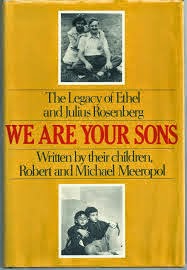
We Are Your Sons: the legacy of Ethel and Julius Rosenberg

from the book log (1/26/89):

We Are Your Sons: the legacy of Ethel and Julius Rosenberg
written by the children, Robert & Michael Meeropol
Houghton Mifflin Co., 1975

Begins with an engrossing selections of letters by Ethel and Julius to their sons, to one another, to Emanuel Bloch, their lawyer, and to the public, most of which were written while the two were incarcerated at the Death House in Sing Sing. Michael Meeropol provides connecting narrative, filling in some of his memories of family life before the notorious spy trial and after. How he and his younger brother (by 4 years) Robert lived for a time with their maternal grandmother. This woman sided with her son David Greenglass, against her daughter and son-in-law and told her daughter as the date of the execution moved nearer: “I mean even if it was a lie, all right, so it was a lie, you should have said it [David Greenglass’ testimony] was true anyway! You think that way you would have been sent here [the Death House]? No, if you had agreed that what Davy said was so, even if it wasn’t you wouldn’t have got this!” Ethel quotes her mother in a letter dated Jan 21, 1953.

Michael and Robert were placed in a Jewish children’s house which Michael remembers as mostly torment. He was seven, Robert three, at the time of their parents’ arrest. From there they went to live with their paternal grandmother, then to a young couple. After the execution of their parents they were adopted by Anne & Abel Meeropol, although at the death of Manny Block they were nearly taken permanently from this new family via legal maneuvering by New York officials.

An interesting and fast-reading book. It gives few details of the trial or the adult Rosenbergs other than those remembered by Michael and, of course, the words of the Rosenbergs themselves in their letters. …

Robert recounts the brothers’ adulthood experiences. Each became involved in the youth movements and New Left of the Sixties, although in somewhat different ways.

Finally the book ends with Michael’s political analysis of the events leading up to and the reasons behind the prosecution (persecution?) of his parents.

I think this is a valuable book. I have a couple other books waiting that delve into the case itself, but this is a rare memoir — the testimony of two innocent victims of the Cold War. And the Death Penalty. Hm. Four innocent victims? I was thinking of Robert and Michael, yet Ethel & Julius went to their deaths proclaiming their absolute innocence.

For my Reader’s Theater class I performed the letter from Ethel Rosenberg which I excerpt above.

Julius and Ethel Rosenberg were executed by the US government in 1953 for providing the Soviets information on creating atomic bombs. Did they do what they were convicted of? If they did spy for the Soviets, was executing them appropriate?

I remember my mother being uncomfortable when she saw me reading this book. I don’t think we figured out how to discuss it. The Rosenbergs were her contemporaries, only 3 to 6 years older, and I’m sure she had opinions about them at the time.

We Are Your Sons was the first work of any substance that I read on the case. Robert and Michael are convinced of their parents’ innocence. It was easy to take their side. How could you not feel for someone whose parents were killed, even if by the state for supposedly just reasons?

My mother was a proponent of the death penalty. As a kid it made sense to me; doesn’t a murderer forfeit his right to life? Gradually my sympathies shifted. The criminal justice system is fallible. Some laws are plainly unjust. I decided it was better not to give the government permission to kill people. Better to err on the side of mercy and put the priority on addressing the social causes for crime than go along with the mistakes that will take the lives of innocents. My mother may have come around. I don’t remember exactly, but I did talk her into changing her mind on some things.

What made me pick up the book in the library? Part of it would have been its uniqueness. Name another memoir written by the child of an executed spy. Part of it would have been a couple novels, which I had either read recently or considered reading at about that time. E. L. Doctorow’s The Book of Daniel was based on the Meeropol boys and was made into a movie in 1983, the title shortened simply to Daniel. I hadn’t seen it but I certainly heard about it. I read The Book of Daniel at some point. Probably before reading We Are Your Sons, but I don’t remember how the reading of either book informed the other. The second novel would be Sylvia Plath’s The Bell Jar, which doesn’t spend much time on the Rosenbergs but has that striking first line: “It was a queer, sultry summer, the summer they electrocuted the Rosenbergs …”

Monday, February 23, 2015

“Unlock Your Heart” by Kenyth Mogan


The sweet crackle of cellophane opens to rainbow candy.

Mostly what pop culture knows of The Wizard of Oz is the MGM movie, and that’s certainly the case here. But that doesn’t mean there aren’t fresh things you can do with familiar elements.

Found this one at Towleroad.

Kenyth Mogan has a Facebook page.

Sunday, February 22, 2015

Fanny and Alexander

from the book log (1/25/89):

Fanny and Alexander.
A film by Ingmar Bergman. 1983. 3 hours 10 min. Watched on TV.

Emilie loses her husband (heart attack?), marries The Bishop who is an ogre and treats her children, Fanny and Alexander, terribly. Emilie finally flees him back to her dead husband’s family.

That’s the extremely condensed version. Quite strange and hypnotic at places, especially when Alexander wanders through Uncle Isak’s house and meets Ishmael. Fanny’s place in the title is her biggest role, tho’ she’s a cute little dickens. Dickens … the story rather reminded me of Dickens. Ghosts and evil grown-ups and big family gatherings. I loved the grandmother and Uncle Isak, just like I was supposed to.

Ingmar Bergman is a giant of world cinema. So by now I should have seen more than one of his films, right? If only for my cinematic literacy. Somehow I’ve never gotten around to it.

I remember watching Gene Siskel and Roger Ebert review Fanny and Alexander on their TV show; what was their show called by that time? At the Movies … Siskel & Ebert & the Movies … ? They loved Fanny and Alexander. Loved it! For some reason a clip they showed of the family playing at a party, especially a man chasing a woman around the dinner table, flickers in my memory. I can’t dredge up anything else. Still, I do remember enjoying the movie, and that it held up throughout its 3+ hours. I can even feel a twinge of anger at the cruelty of the stepfather, though perhaps that’s more from reading an overview of the plot than anything else.

The Criterion Collection makes available the 5 hour version that showed on Swedish television, for those who want to see Bergman’s “vision … expressed at its fullest.”

Saturday, February 21, 2015

a cold wind off the ocean

from the diary (Tuesday, 1/24/89):

”What are you thinking?” said Glenn to Garin.

“I was just thinking I’d like to take time off from work and go up to the snow.”

“Do you ski?”

“No. Everyone I know who’s gone skiing has broken something. I used to love to sled.”

“What else are you thinking?”

“It’s blank. I’m not thinking anything.”

“The wind blows right through, hm?”

“What are you thinking about?”

I said: “You.”

Garin and I went to the beach today — Salmon Creek. Mom says they are going to be closing [the] old favorite parking lot but they haven’t yet. The weather was gorgeous. No fog. We got there early — elevenish and the beach was actually warm for a couple hours. A brisk wind from the ocean became quite chill on the way back to the car but the sun was still comfortable. …

Garin claims he was badly hurt during the affair with David W. … These people who say they are so hurt by a previous relationship that they … [w]on’t … jump into anything — … seem to jump [pretty fast] when they find Mr. Beautiful.

As I remember it, the wind off the ocean was so sharp and cold that it drilled into my ear and brought on a headache, which eventually turned into a migraine, probably one of my more memorable if only for the poetry of it. Garin and I did not go out on another date.

Friday, February 20, 2015

Pumpkinhead

from the book log (1/20/89):

Pumpkinhead
This is a monster movie. A fairly well-made old fashioned monster movie mercifully shorn of gobbledygook.

You have the minimal characterization — stock characters — the horror of justice and injustice, the teenagers, the ugly monster. You see, this group of youngsters goes to country to ride their motorbikes — a little boy gets run over by one. The daddy gets very pissed and asks the wicked old witch of the forest to sic Pumpkinhead on the bad old kids. Pumpkinhead does a pretty good job but every time he kills Daddy goes all funny inside. Daddy decides he’s done bad, rushes to save remaining kids. As a change of pace I thought Pumpkinhead might kill the “good girl,” the good girl has been surviving too many of these [horror] movies. Let’s have a slut come out on top.

Pumpkinhead had decent special effects, enough corniness to make you feel good & a few scary parts — generally above average for the genre. Unfortunately, I should prob’ly say, it is likely well above average.

Maybe give it a B+. Your basic scary fairytale ghost story.

I met my brother in Santa Rosa to see Pumpkinhead. David was riding his motorcycle, wearing the Christmas present Mom gave him, a helmet! We both enjoy a good monster movie. I no longer say I like horror movies. The genre got hijacked by the serial killer. In a monster movie the monster is out of this world, supernatural or extraterrestrial, and the humans unite against it. In serial killer movies the monster is too human. That’s no fun.

There’s a character in the Oz series named Jack Pumpkinhead. Jack is a somewhat flimsily constructed wooden man with a carved pumpkin for a head. Though Jack’s character is sweet and innocent, he is tall and that jaggedly carved grin is a little scary. I was hoping the monster in the movie would be a little bit inspired by Jack Pumpkinhead. Sadly (or fortunately) I must say there is no resemblance.

Thursday, February 19, 2015

A Handful of Dust

from the book log (1/18/89):

A Handful of Dust
Evelyn Waugh. 1934

This is the first novel I’ve read by Mr. E. Waugh. The movie version was playing in London while I was there, but I dint see it. The book is a new paperback edition with a promo photo of the three actors who portray the main characters. One, the one (I suspect) who plays Tony, was Maurice in the movie Maurice (or he looks like the same guy) [James Wilby]. The one who must be John Beaver [Rupert Graves] is very sexy in a white and black sort of way.

I enjoyed the book although the ending is quite dastardly. It’s a Very English novel. Upper crust sorts going to parties, saying clever and witty things, emoting in the most subdued ways. Tony & Brenda Last seem to be enjoying a harmonious and loving marriage, but then Brenda unaccountably falls for the unlikable John Beaver who (unlike Tony) has no money and is described by one character as “London’s only spare man” as he is often invited to parties merely because a previous invitee couldn’t come. Brenda leaves the Last estate for an apartment in London where she carries on with John (unbeknownst to Tony). Tony & Brenda have a son also named John who is killed about this time in a riding accident. (The two children in the novel, John and Winnie, the child of a prostitute, are quite unpleasant creatures.) The death precipitates divorce, which Tony ultimately decides not to go through with. In a bizarre turn Tony decides to accompany a boisterous explorer to the wilds of Brazil to find a lost city. Where this came from I don’t know — it’s quite unexpected. They never find the city, by the way, and John Beaver, the opportunist, doesn’t do well by Brenda and, except for some people we don’t know, there isn’t really a happy ending. Very odd. Lots of eccentric folk populate the scenes and every happening is recounted in the same wry, dry tones. The narration is not at all intrusive. I liked the feel of the style, the words.

I have not read any more Evelyn Waugh, not even Brideshead Revisited, which I keep thinking I should read. I know I have a copy around here somewhere. Probably a move tie-in paperback.

Wednesday, February 18, 2015

The Lair of the White Worm

from the book log (1/17/89):

The Lair of the White Worm, produced & directed by Ken Russell, based on the novel by Bram Stoker.

Went to the Plaza tonight with Rodney Aho. This was a fun movie. Lots of weird goings on but nobody was quite as seriously absurd as in the usual horror/monster flick; no, they were serious sometimes and absurd sometimes. Lots of little (and not so little) sexual innuendos throughout. A sexy villainess with great vamp costumes. A film for the jaded — it even had some scary parts. Lots of evil going on. The silly explanations were kept to a minimum and only a few rubbery special effects. A worm/slash/dragon lives in the big cave on the hill and the mysterious woman periodically sacrifices folks to it. Until she is outwitted by our wily hero(es) and she & dragon meet their doom. Pretty much.

This is Dare I Read post #1000.

Tuesday, February 17, 2015

Odyssey: the Inca Empire

from the book log (1/16/89):

ODYSSEY. A regular TV series made circa 1980. This episode about the Inca Empire.

Potentially dynamic information and locales exhibited in the typical dry, overawed, museum tones of the archeological documentary. Some fascinating stuff. The knotted ropes that recorded the huge civilization’s holdings and transactions, the long, well-maintained roads, the system of labor tax whereby each person worked for the government, whether building road or city or agriculture or textile making on a rotating basis, the arrangement of agriculture to best advantage, taking into account native plants & animals and using as assets their adaptations to specific habitats. These Andean people used a method of freeze-drying that effectively preserved food for years. The cities were not occupied with resident populations but with people doing their labor taxes, consequently the toppling of organization with the coming of the Spaniards emptied many of the cities rapidly.

I found the pre-Columbian American empires of the Incas and the Aztecs fascinating (well, I was a bit skittish about the Aztecs what with the scary heart-cutting-out sacrifice stuff). Exploring these civilizations was part of why I chose Latin American Studies as my major at UC Berkeley.

A 9-minute preview:

Monday, February 16, 2015

Masterpiece Theatre: A Very British Coup

from the book log (1/16/89):

Masterpiece Theatre: A Very British Coup.
aired in 2 parts: Jan 15, 9:00-10:00pm and Jan 16, 9:00-11:00pm on channel 9, KQED

An interesting entertainment. Lots of quick cutting from scene to scene, overlap of dialogue & background noises as locale changed, lots of extreme close-ups, the faces from lower lip to eyebrow filling the screen. Well-written drama about a “radical” from the Labour Party left, Perkins, [who] wins a landslide victory. He tells the U.S. to take its bases and go home. He dismantles the British nukes. He fights a CIA-led electric power workers’ strike. And there’s a happy ending that almost seems plausible.

Sunday, February 15, 2015

“a readaboutable life”

After talking about looking over my senior yearbook (1983), I wrote in my diary (1/15/89):

Then, of course, I pulled out an old diary — from ’86, not that old. Was actually rather entertaining. I was attending Day Treatment at the time. [Day Treatment was a mental health program.] I think I was trying to make my diary fun to read. I have all these journals full of poetry and prose. It’s quite amazing. All this stuff. A resource. It can take credit for it. I can loot them for the good stuff. And say, oh, I wrote that. Hm. I’m glad I wrote all that. Even if much of it’s crap and much of what I write now is crap. Not all is crap. I don’t know how to talk about this. It just seems weird. I have a readaboutable life.

The next day (1/16/89 “Martin Luther King Jr. official b-day celebration”) I continued this thought:
I’m starting to look at my journals as a treasure trove. You run your hands through the pieces, the woven & wrought lengths or rings or garments, some are unremarkable, disappear into the pile, some seem to sparkle. So today I typed up ‘Mrs. Alabaster,’ a storyish thing I wrote in 1986. I’m going to send it to Fantasy & Science Fiction and see if it’s good enough to attract comment. I’m dissatisfied with it as a story but I like the prose.

“Mrs. Alabaster” attracted a rejection slip. Any comment? I would have remembered a comment.

Since I’m looting my old diaries “for the good stuff,” I thought I’d give a nod to my old self and all the “crap” he piled up that I now “run [my] hands through.” Here’s to you, me!

Saturday, February 14, 2015

Book of Love. Book of Love

from the book log (1/14/89):

Book of Love. Book of Love. a record album.

This is not a great album. I remember [the band’s] name from KITS — LIVE 105.3 — I thought I really liked them. I think I got [Book of Love] and Colourbox mixed up. Anyway. They’re not terrible but neither do they stand out. “Modigliani (Lost in Your Eyes)” reminds me a lot of Peter Gabriel’s “In Your Eyes.” “Boy” is the song that sounds familiar; prob’ the one I heard on LIVE 105.3. “Yellow Sky” is my fav. track but that’s not a wild recommendation. Somewhat danceable, too ordinary synthesizer semi-mellow pop. Awful lyrics. From “Modigliani”: “You knew what / I was thinking inside / with one look / of your all seeing eyes.” From “I Touch Roses”: “If you think I’m magical / cause roses bloom with my touch / but magic’s just not practical / I think you think too much.” Very vacant, full of cliches and stupid “relationships/love.”

I must still have this. I haven’t sold or given away any of my vinyl. Not that I’ve listened to it in years. I don’t understand the vinyl revival. Vinyl is such a hassle. If the sound is so much better it’s nothing my ears can detect. Pops and clicks, yes. I think I picked up a clearance bin CD of Book of Love thinking I was missing something. But I never played it.


Friday, February 13, 2015

Our Time Has Come: a delegate’s diary of Jesse Jackson’s 1984 presidential campaign

In 1988 Jesse Jackson made a second run for the presidency. I remember splitting my California Democratic primary delegate vote between Jesse Jackson and Sen. Gary Hart. Did I do that in 1984 or 1988? Looking over the Wikipedia pages for the campaigns I’d guess it was ’84. I’m pretty sure I was ready to go all in for Jackson in 1988; besides, I don’t think you could split your vote the same way in ’88.

I attended my first (& so far only) presidential campaign rally when Jesse Jackson came to the Santa Rosa fairgrounds to give a speech. I remember Eric Shanower wearing a Jackson ’88 campaign pin at the Oz Convention that year. (When I met Kent I discovered two Jackson ’88 campaign coffee mugs in his kitchen. We still use them.)

As an out gay man I was sick of the Democratic squeamishness around my kind, an attitude that hobbled the fight against AIDS as well as limiting the recognition of equality. Jesse Jackson spoke out for gay people and for major funding in the AIDS fight. It was thrilling seeing him win state primaries. It felt like there was Hope.

When I spotted Our Time Has Come at the library I was looking forward to at least some discussion of the ’88 run. Got none.

from the book log (1/13/89):

Our Time Has Come: a delegate’s diary of Jesse Jackson’s 1984 presidential campaign by Lucius J. Barker. 1988. University of Illinois Press

It’s curious that the book, emerging in 1988, deals exclusively with Jackson’s 1984 campaign. A bit disappointing because one would like some comparisons and contrasting of the ’84 with the ’88 campaigns.

Lucius Barker does go on. Goodly portions of the book could be excised without trauma (without noticing). He chose a strange middle ground between objective analysis and personal involvement narrative — strange because I got such a sense of “neither here nor there.”

Barker talked an awful lot about his objective/subjective dilemma — he talked about his dilemma. [I didn’t record what Barker’s “objective/subjective dilemma” was exactly, but I’ll guess the dilemma was what stance to take when writing about the campaign.] The old saw: Show, don’t tell. He does a lot of tell. Not nearly enough show. Yet until I find a better book about Jesse’s campaign this is better than nothing. I liked Barker’s observation that, win or lose, Jesse’s campaign gave a lot of minority and social justice-type people valuable experience in running a national presidential campaign, experience you can’t get elsewhere. Hope some of these folks move into positions of power and leadership because of Jesse’s runs.

The campaign began with black leadership divided between Jesse & Mondale, then came Lt. Goodman’s Jesse-made release from Syrian prison, then the overblown Hymietown remark, the frustrating convention where all of Jackson’s minority planks were not only defeated but ignored and the boffo speech (which is reprinted in this book and; reads well too).

The “delegate’s diary” of the title is just one chapter but gives a feel of the convention. More show than tell, finally.

I’ll make the prediction that if Jesse runs in 1992, his negatives will have come down — not all the way but some, and he will be first or a close second in those stupid “if the primary were held today for whom would you vote” polls in early 1992. Whether he’ll stay on top I won’t predict but I do think he’ll do better than in ’88. I’m not sure he can remain a perennial presidential candidate too many more years. ’92, I think so. ’96? The year 2000? I’m inclined to doubt that he’ll be a big force unless he does gain the presidency in the 90s. Who knows. What is he doing now I wonder … He made some statement about how corruption is not a color issue & bad when anyone engages in it, in reference to Marion Barry, Mayor of Washington, D.C., & the trouble Barry is in.

Jesse Jackson did not run again in 1992. I thought Jackson could build on his ’88 successes, since there was no Democratic incumbent and the people who had supported him were as ignored and discounted as ever. Arkansas Governor Bill Clinton came along and spoke up for gay people in a way no one had. Despite my doubts about a Southern politician really being there for us when the going got rough I pinned a Clinton/Gore political button to my college backpack.

Thursday, February 05, 2015

postcards

from the diary (1/13/89):

I mailed a few postcards today. To Eric [H], Lary, Jeni (saw her last night at the library coming to use the photocopier, she gave me her new SF address), and Chris [B].

I had a lot of people to write to when I was in London. I got in the habit of writing postcards. A lot of postcards. It was a habit I tried to keep up once I got back. I will still occasionally address a big stack of postcards and spend a few days squeezing a tidbit of news into the space a postcard provides. It helps when there is some news, but even when there isn’t I think it’s nice to get mail and be confirmed that somebody is thinking of you, isn’t it? Sure, there’s email, which is so easy, but physical mail with real ink scrawled by a human hand with a pretty picture on the back … something about it.

Wednesday, February 04, 2015

The Color of Honor

from the book log (1/11/89):
The Color of Honor documentary, 1987, 1 1/2 hours, shown on KQED

Another very effective and informative documentary. Focused on the students of a U.S. Army language school who became interpreters throughout the Pacific Theater [during World War II]. These interpreters were Nisei — young men born in America to Issei, parents who had immigrated here from Japan. The Japanese-Americans of Hawaii were not interned and many young men from that territory volunteered enthusiastically for the Armed Services. But, of course, many Japanese-Americans were interned on the mainland [out of the racist supposition that they were likely to betray the U.S.] and their treatment was disgraceful.

Tuesday, February 03, 2015

Fighting for Our Lives


from the book log (1/11/89):

Fighting for Our Lives, documentary on KQED, the San Francisco PBS affiliate. Narration by Linda Hunt. Produced in 1986? 1987? The latest dates mentioned were in 1986. (30 minutes)

This is a very good to excellent documentary. About as deep as this audio-visual medium can get. Made me drip a few tears. AIDS. They interviewed Randy Shilts among others, gave a brief overview of gay history in San Francisco, talked about the way AIDS crept into consciousness. Gay plague? Originally people scoffed, but when it hit home how real and deadly was this thing, behavior as well as attitudes changed. One in three gay men in San Francisco is expected to die. Yet the gay community is now a community in ways it never was before, with community support services, choruses, marching bands, theatre, food banks, health care, political action, bowling leagues, and so on. The makers of this doc stressed how the existence of an out gay population in powerful positions in the area made the model AIDScare program. Highlighted the efforts of lesbians. Interviewed Roberta Achtenberg.

I found the documentary on youtube. Throughout, and distractingly, “Fighting for Our Lives” hovers over the lower third of the screen, added, I'm sure, for the youtube version.

The bit in my log entry about the gay community being “a community in ways it never was before,” etc. seems to be paraphrasing Randy Shilts.

Sunday, February 01, 2015

DONAHUE

My mother was a DONAHUE fan. Phil Donahue’s talk show addressed serious issues that the cooking and celebrity focused talk of other daytime programming ignored. Abortion, gays … According to Wikipedia, consumer advocate Ralph Nader was Phil’s “most frequent guest.” Each episode’s guests would be seated on the stage and Phil would circulate through the audience with a handheld microphone offering audience members the opportunity to ask questions of the experts. It was a democratization of the questioning that was really refreshing, for a while, at least. DONAHUE gave me a chance to see real live gay people speaking up for themselves, witnessing for their lives. Even before I dealt with my own unresolved same sex attractions, I was fine with rooting for the gays who certainly should be able to live forthrightly, legally and safely. On DONAHUE questioning tended to be respectful. I don’t recall Phil necessarily including “the other side;” that is, the bigot contingent wasn’t obligatorily presented as a valid and equal authority on whether everyone got to have civil rights.

from the book log (1/11/89):

DONAHUE

The Supreme Court has decided to review a Missouri law (?) that restricts abortion. So Donahue had a couple anti-abortionists, both young women (relatively) and two women who were pro-choice; and some guy from The New York Times (formerly) who reports on the Sup Ct gave a rundown on how the nine will likely vote. It infuriates me how the “pro-life” fools call the terms of the debate. [Those] who define the terms have already won. I thought of a “pro-life” counterpart. Why not call the pro-choice advocates “real life counselors,” or something. The Real Life Action Coalition.

Also the hour talk show — [with commercials] some hour — when dealing with a complex subject like this cannot even sketch the real situation. And the “debate” becomes largely a repetition of slogans and a shouting match — the pro-choicers never shout loud enough, they are too nice. More men stood up than I ever remember in a Donahue audience. [Is this irony?] The [men] were speaking on both sides of the issue — as were the women. The show’s concluding comment was from a teenage girl and she was cut off by the credits. I thought she made one of the best statements in the show because it was a chance to turn the debate. She said the “pro-lifers” seem so concerned about the “unborn children,” what about the “born children”? The “pro-lifers” seem uninterested.

The case that the DONAHUE guests were addressing was called, Webster v. Reproductive Health Services. The Supreme Court ultimately decided that the states could further restrict abortion, despite the Court’s earlier declaration in the Roe v. Wade decision that abortion was a right women held under the Constitution.

A few days ago there was a diary at DailyKos about Ohio Rep. Tim Ryan’s change of position on abortion. After listening to women describe situations that made their decisions about whether to carry a fetus to term something other than a simplistic Shall I Kill My Baby?, Ryan decided he would no longer vote to make abortion illegal. I left a comment:

I’ve been rereading my diary from 1989 and I came across a formulation that I proposed -- instead of Pro-Life being opposed by Pro-Choice, it seemed to me more accurately one should contrast the fantasies behind the "Pro-Life" position with "Real Life" as lived. Whatever we learn about fetuses it will still be true that they are sited in grown persons and that the real lived experience of the person must take priority.

“These women gave me a better understanding of how complex and difficult certain situations can become,” says Rep. Ryan.

It's easy -- way, way too easy -- to imagine a few cells burgeoning with potential as having a right to life, a right to develop into a human being. Why is it so so difficult to imagine the grown human beings struggling with all the things we have to deal with and recognize that some will make choices that nip the potential of those burgeoning cells? And that punishing women for making this decision is, at best, counterproductive to the professed (but actually fantastical) Culture of Life?

Real Life versus Your Dreamland.

Rep. Ryan woke up to reality?

In a debate it probably doesn’t help to accuse the other side of living in a fantasy world.

Anyway, let’s get back to the gays for a paragraph. I remember trying to suss out my attraction to boys by debating whether I felt any physical draw to Phil Donahue. Not even when he took off his shirt to be bound in clear plastic wrap on a show about packing your fat tightly so you wouldn’t look flabby. Not even then! Well. I will admit I did stick out the whole episode to make sure.

screen capture of 80s Donahue source

Tuesday, January 27, 2015

pile of reading

The Reenactments by Nick Flynn
Nick Flynn wrote a memoir, focused mostly on his father, called Another Bullshit Night in Suck City. I loved the title. Finally read it and thought it very good. The book was turned into a movie, Being Flynn, starring Robert DeNiro. I’ve seen maybe half a minute of it on TV. The Reenactments is an essay about having a movie made about your life, including the really bad parts. Among other things Nick Flynn tries to figure out if seeing an actress portray his mother committing suicide will help him heal from that tragic and traumatic real life event. He never really has, he says. We revisit many stories covered in Flynn’s first memoir, often from a slightly different angle.

Poetry v. 203, no.4, January 2014
Several years ago I read a year’s worth of Poetry and came away thinking the magazine was quite unreadable. A few more recent issues edited by Christian Wiman fell into my hands. Upon reading them I found the magazine greatly improved. Wiman has also been replaced. Changes, changes. Maybe it’s time to give Poetry another go? I ordered up the January through April issues from the Berkeley Library Main Branch. I’m working my way through January. The editor, Don Share, seems to have decent taste. It’s a little early to pass judgment, but passing judgment isn’t really necessary, is it? Inevitable, I suppose. But necessary?

What Light Can Do: essays on art, imagination, and the natural world by Robert Hass
Robert Hass was one of my teachers at UC Berkeley. He went on to serve as U.S. Poet Laureate and win lots of awards. This collection is a motley. I enjoy Hass’ voice but all the essays are not equally interesting.

Notes on the Mosquito: selected poems by Xi Chuan, translated by Lucas Klein
In the What Light Can Do collection Robert Hass talks about recent poetry in mainland China. One of the poets he singles out is Xi Chuan and I liked the lines he quoted.

Against Forgetting: Twentieth Century poetry of witness edited by Carolyn Forche
Lots of downer poetry. Still, I’ve slipped in a few bookmarks and poems from this anthology may show up in my year end list.

Mixed Up: a zine about mixed race queer & feminist experience
I picked this up on an expedition to a zine shop in the Mission.

A Short History of Laos by Grant Evans
I enjoyed A Short History of Cambodia. This book is in the same series, though by a different author. We’re considering a visit to Laos.

Mouth poems by Lisa Chen
Lisa Chen was a classmate in a Robert Hass poetry workshop at Cal. I found she had a book so here I am reading it.

The Man Who Folded Himself by David Gerrold
A science fiction novel about traveling back in time to help yourself out.

Monday, January 26, 2015

The Davey Thunder / Jack Lightning Show

My brother, David Lee Ingersoll, is a comics artist and writer. In the 80s he produced a number of mini comics. After doing a horror anthology series called Cheap Thrills and a series devoted to the adventures of two recent creations, Moe & Detritus, David decided he wanted to revisit characters he and I invented as kids. David asked me to write a script. Davey Thunder and Jack Lightning were the names we chose for a couple brief guest shots as DJs on an older friend’s radio show on the Sonoma State University station KSUN. We created a couple supporting characters, too — an Elf (David would introduce the elf by tapping a toy xylophone) and a Dragon with nasal congestion (yes, I talked wid by doze ah glogged ub).

from the diary (1/10/89 Tuesday):
I wrote a Davey Thunder / Jack Lighting script: The Origin. I folded it up and stuck it in an envelope, walked it down to the mailbox outside the post office. David should have it tomorrow or the next day.

from the diary (1/11/89 Wednesday):
David called up and said he liked the Thunder & Lightning script. He’s working on the third Moe & Detritus mini comic, but figures when he’s done with that he’ll get to work on T & L. He wanted to retitle it: GENESIS. Yuck! I said. I said I thought that sounded too pretentious. Well, he hates the word ORIGIN. (My title was: THE ORIGIN.) I said I hated it too, but that was why I used it cuz it conjures up so much awfulness when you think of comic books. Oooh. The Origin. What’s his origin? Here’s the “Origin Story” — Because you demanded it! I suppose the other reason David thought of Genesis was cuz I followed the Genesis of the Bible. You know, Let there be light, God created man in his own image, etc. Calling the comic “Genesis,” though is belaboring the obvious and making too important the similarities, making too immediate the comparison.

With “The Origin” I produced an origin story for the series that began with the creation of the universe and didn’t explain the main characters at all. They were sort of narrators? I was really happy with the way David realized the script. It was pretty wild seeing stuff I’d pictured in my head appear as pictures on the page. I do remember one point of variance. In the script I called for a “Hun” to appear. In my head I was seeing a German soldier — nicknamed “Huns” by British propagandists during the First World War. David went back to the Mongol Hordes for the look. I decided his interpretation made as much sense as mine (or more, maybe) so I never said anything about it — until now!

An issue of The Davey Thunder / Jack Lightning Show appears in Treasury of Mini Comics edited by Michael Dowers and published in 2013 by Fantagraphics.

Wednesday, January 21, 2015

Black Mondays: worst decisions of the Supreme Court

from the book log (1/8/89):

Black Mondays: worst decisions of the Supreme Court by Joel D. Joseph, foreword by Justice Thurgood Marshall

I didn’t find [all of] Joseph’s choices equally horrendous but some were undoubtedly spine-chilling.

The International Longshoreman’s Association (ILA) chose to protest the Soviet invasion of Afghanistan by refusing to unload Soviet goods. An American company which imports Russian wood sued for loss of business. The Supreme Court awarded the company several million dollars to be paid by the ILA. Joseph likens ILA’s boycott to the Boston Tea Party. He gets all puffed up about how there wouldn’t have been a revolution if not for the Boston Tea Party. I didn’t really get the connection. From what I understand about the Boston Tea Party, it was a symbolic violent act that we can all point to and say, “Ah! Something happened!” but it didn’t really have much effect. The Boston Tea Party was violent and would be illegal if it happened today. The boycott of tea by the population brought more results. People just didn’t buy tea for a while because the taxes were so high. I’m not sure the analogy is the appropriate one. I need some clarification as to why the Supreme Court’s decision was so terrible.

The book also contained, very appropriately, the 1986 Georgia sodomy decision in all its awful glory. I think I’ll photocopy the pages.

Thurgood Marshall in his foreword says, “I [do not] find the wisdom, foresight, and sense of justice exhibited by the framers particularly profound … the government they devised was defective from the start, requiring several amendments, a civil war, and momentous social transformation to attain the system of constitutional government, and its respect for the individual freedoms and human rights we hold as fundamental today.” He says, “We the People,” for instance, didn’t mean black men or any women. He contends that the framers’ motives really weren’t too pure. Joel Joseph disagrees some, and in his introduction calls the Constitution “an excellent document.” [Joseph] says, “Most of the problems cited by Justice Marshall stem from those whose duty it is to interpret the Constitution.” He calls for some reforms: “A Constitutional amendment providing for judicial terms of ten years (with five years of additional salary for retirement or for a buffer period) would give judges independence while injecting new energy into the judiciary. An excellent judge could serve ten years at the district court level, ten at the appellate level, and ten at the Supreme Court. No judge would be allowed to be reappointed at the lower two levels. At the Supreme Court reappointment would be reasonable because the Senate exercises careful monitoring of the highest court.” [On the other hand because] the principle of ‘one person, one vote’ is violated by the [way] U.S. Senat[ors are elected, Joseph] propose[s] “the Senate be kept to one hundred [members, with] each state getting at least one.” The other 50, he says, should be apportioned by population. New York would get eight, say, while Wyoming would have to be happy with its one.

Ralph Ginzburg, in an early ‘60s case, ended up going to prison for eight months because he sent through the mails material (magazines) the Supreme Court decided were obscene, were pornography. One book he was convicted for distributing had, before being offered to the general public, been sold to “medical and psychiatric professionals.”

In another chapter Joseph says Congress should amend the postal law so that non-profits & individuals aren’t breaking the law when they put unstamped letters, notes or pamphlets in private mailboxes. He says, as to door-to-door salesmen, cities should not be able to prohibit them tho’ private citizens should be able to post “NO SOLICITORS” signs & expect these to be respected.

He says the Dred Scott decision (keeping the man & his family slaves) helped lead to the Civil War.

And Plessy v. Ferguson. Hmph. It still rankles that Chris & Julie think the Supreme Court justified in their decision. [Chris & Julie were American friends I hung out with on the London trip.] Plessy was arrested when he refused to vacate a “white” railcar. He was 1/8 black. Blacks were allowed to ride in white cars if they were “nurses” of white children. The railways disliked the laws because segregation was “inconvenient and expensive,” Joseph says. Plessy’s lawyer called this Jim Crow law “obnoxious to the fundamental principles of national citizenship, perpetuates involuntary servitude … under the merest pretense of promoting the comfort of passengers on railway trains.” The Supreme Court majority, in its ruling, cited as precedent a decision made before the Civil War.

Then there’s the awful Korematsu case in which the Supreme Court upheld the right of the Gov’t to intern the Japanese Americans.

And the Court’s rulings against the rights of women, even though the Constitution nowhere makes a distinction between male and female. Hm. “one man, one vote”?

A horrible case in 1987: the Creighton family, says the Court, can’t sue the government for barging into & searching their home, assaulting them, all without a warrant, supposedly (tho’ not actually) in hot pursuit.

Joseph ends with the sterilization of Linda McFarlin/Sparkman who got it done without even knowing it (Mom told her it was an appendectomy); and the cases of servicemen dying of cancer who aren’t allowed to sue the government.

A good book.

from the diary (1/10):
I memorized the first four amendments to the U.S. Constitution the other day when I was reading Black Mondays: Worst Decisions of the Supreme Court. The book reprints the Constitution at the end. I finished the book with Peanuts [the cat] in my lap, and he was settled so nicely I dint have the heart to disturb him so I decided to memorize the Bill of Rights. I only got so far as the 4th Amendment & a phrase from the Fifth. I still remember them! How long will it last?

Remarkably I have retained the Second Amendment all the years since. “A well-regulated militia being necessary to the security of a free state, the right of the people to keep and bear arms shall not be infringed.” I did not have to look it up, and, yes, I got it right. I think what kept it in my head was the precondition of the “well-regulated militia” to the “right of the people to keep and bear arms.” How did this get interpreted to mean otherwise? Cue Joel Joseph: “Most of the problems cited by Justice Marshall stem from those whose duty it is to interpret the Constitution.”

Saturday, January 17, 2015

word of the day: enfeoff

context: “There is nowhere to be found in the … present day the kinds of loyalty shown by Tokugawa Hidetada, who on the strength of a firm commitment made in his youth, enfeoffed anew Tamba Nagashige after he was vanquished at the Battle of Sekigahara; or by Naoe Shigetsugi, who remained true to Uesugi Kagekatsu to the very end.”

from a letter by Iwata Jun’ichi, August 20, 1931

definition from OxfordDictionaries.com: (Under the feudal system) give (someone) freehold property or land in exchange for their pledged service.

I’m not so much interested in the definition as in the look. Those three Fs! It feels a little weird in the mouth, too. Oh, according to the list of words with which “enfeoff” rhymes listed at Oxford you don’t pronounce the O. Tsk. Rhymes with beef, belief, brief …

So let’s see if I have this right. The lord, Tokugawa Hidetada, reups the contract of military commander Tamba Nagashige despite leadership that resulted in a rout at some big battle. The lord felt committed to the soldier out of a commitment the lord “made in his youth.” As Iwata refers to this connection in the context of a discussion of homosexuality one might suppose there is a close personal component to that youthful commitment. Whether this heart entanglement led the lord to a poor military decision or if it turned out okay in the end (thanks, love, for getting a word in!), I don’t know. I tried a little light Google research and I’m afraid I don’t feel much more illuminated. Hidetada seems to have had a mixed career after the Battle of Sekigahara but keeping on a defeated military commander wasn’t determinative. So far as I could tell.

source: Partings at Dawn: an anthology of Japanese Gay literature edited by Stephen D. Miller

Friday, January 16, 2015

“there’ll be plenty of time to die in if it comes to that”

Once you understand you can kill yourself whenever you want to, or imagine you’ll find the guts for it when necessary, time ceases to exist and something strange happens. A lifetime seems both too long and too short at the same time. That’s when you realize there’ll be plenty of time to die in if it comes to that, and you learn to tough it out. [Choosing not to kill myself] sounds like solid existential resolve now, but in fact it was cowardice. When I couldn’t pull the trigger, I had to convince myself that living actually took more courage than quitting the game. … I couldn’t think of what I needed to do for myself, and I struggled with the knowledge that I was always going to be alone because I couldn’t figure out what it took to be with another person. The idea of spending the rest of my life without love was killing me. Still, this wasn’t a serious suicide attempt, it was just pushing myself in that direction to see if it made any more sense than the terminal isolation … [A]nxiety and panic attacks [had] followed me into my thirties, and … sometimes drove me to extremes of despair.

That’s Stephen Zanichkowsky writing in his memoir. The skills he developed for coping with an unhappy childhood did not transfer well to adulthood. He got Depressed. It’s not a good place to be in, Depression. If you feel trapped in it, the only way out may seem to be the permanent ending.

Zanichkowsky talks about “courage” in the passage above. “I had to convince myself that living actually took more courage than quitting the game.” He means that the better course is the more courageous? Nobody wants to be thought a coward, even in the grave. “[B]ut in fact [choosing not to kill myself] was cowardice,” he says in the sentence preceding. Courage and cowardice come up frequently in discussions of suicide.

Is it more courageous to live? Or more cowardly?

In the passage I quoted by Chris Stedman last year, the young Stedman also decided not to kill himself. He also talked about cowardice: “I couldn’t will myself to go through with it. I was too afraid.” Unlike Zanichkowsky, Stedman then lists a few things of which he was afraid: “of the selfishness of this act and how my family would react to it; of the physical pain involved; of failing at this, too; but most of all of the fate I was sure would greet me after death.”

Zanichkowsky says he no longer considered himself Catholic and was more bemused by his mother’s fear for his eternal soul (endangered by suicide, you know) than bothered by the notion of a nasty afterlife. Stedman says the afterlife was what scared him most of all. I’ve contemplated suicide; post-death punishment by God has never been a factor in my decisionmaking.

But the opening sentences in the Stephen Zanichkowsky passage say something I don’t recall having heard discussed elsewhere:

Once you understand you can kill yourself whenever you want to, or imagine you’ll find the guts for it when necessary, time ceases to exist and something strange happens. A lifetime seems both too long and too short at the same time. That’s when you realize there’ll be plenty of time to die in if it comes to that, and you learn to tough it out.

Contemplating suicide can be empowering. If you have given yourself permission to kill yourself, you realize you have power, the power to destroy, the power to end all the pain, but, most curiously (for one feeling powerless in the throes of Depression), the power to decide for yourself and the power to act. You will die some day anyway. If the ultimate choice is yours, other options, which may have seemed bad, now just seem different. Different choices. “A lifetime seems both too long and too short at the same time.”

source: Fourteen: growing up alone in a crowd by Stephen Zanichkowsky

Thursday, January 15, 2015

Arrowsmith

Sinclair Lewis is better known for Babbit and Elmer Gantry than for Arrowsmith. But I’d heard of him and what I’d heard was good and when you’re picking through the paperbacks and dust-jacket-less hardcovers at the library book sale in Sebastopol you’re faced with a lot of sway-spined best sellers which usually aren’t any good so you choose an author with a rep when you offer up your fifty cents for the good work the Friends do.

So there on the home bookshelf sat the acquisition, taking up the space unread books take up, potential, seemingly limitless opportunity to get around to it, space that might (who knows?) be better used.

The book log entry for Arrowsmith is longer than most. The first paragraph gives a thumbnail of the plot, from beginning to end. It’s not till the second paragraph that one gets to my discontents.

from the book log (1/8/89):

Arrowsmith by Sinclair Lewis

This novel took a while to read. And not, I think, just because it is over 400 pages in length. Martin Arrowsmith becomes a doctor during the course of the novel, marries Leora. He attends medical school in the state of Winnemac, goes to practice as a country doctor in Leora’s hometown, Wheatsylvania in “the Dakotas,” moves on to the medium-sized city of Zenith where he works for the Dept of Public Health, on to Chicago for a year as a pathologist in an expensive private clinic, on to New York where he works at the McGurk Institute, a scientific research institute, under the guidance of his old medical school teacher, “pure” scientist, and minor demi-god Max Gottlieb. Martin, Leora, & Sondelius, a worldwide crusader against epidemics, go to the Caribbean island, St. Hubert, to defeat the plague with bacteriophage. Leora dies; Sondelius dies; back in NYC Martin is acclaimed, marries the very rich Joyce Canyon (who was also on St. Hubert during the plague). Eventually Arrowsmith chucks it all to go back to “pure” research in the wilderness with colleague Terry.

The edition also includes an Afterword by Mark Schorer. He calls the ending, “a little fantastic … and quite unpersuasive.” I agree. I thought Martin a boob. I liked him some, found him at least interesting enough to want to know what would happen next. But his addiction to “scientific method” in the midst of the plague was never adequately explained — because the experiments were not perfect [the researchers] couldn’t tell [whether] the bacteriophage was really what was curing people. Yet [sick people] were doing a pretty good job of being cured. This reminds me a bit of the conflict over AIDS treatment. When we’re talking terminal illness, making noises about imperfect controls — meaning some people are not given treatment, treatment is actively withheld — seems pretty ridiculous. No experiment is going to be perfect because there are always going to variables that aren’t considered. If it helps, isn’t that what matters? Even if it just seems to help, that’s important too. My favorite character was Leora. I dint think Martin deserved her. She did annoy me in being rather vacant. I didn’t find Gottlieb as sympathetic as he was supposed to be.

In my recent visits to Sebastopol I’ve found some decent items on the Friends sale table.

Wednesday, January 14, 2015

Cocteau Twins. Blue Bell Knoll

from the diary (1/5/89): “bought a copy of The Cocteau Twins’ latest Blue Bell Knoll, which was in the used file at the Last Record Store [in Santa Rosa].”

from the book log (1/6/89):

Cocteau Twins. Blue Bell Knoll, a record album

I bought this a few days ago and enjoy playing it. Little of it is danceable, which is one of my big points for buying music, but once I put it on I usually end up sitting down and reading. The music flows around and through me. I like it. It’s not just mood music, but it’s very atmospheric.

Now that music so easily surrounds one, no need to get up and go to the turntable, and now that I can afford it in a way I certainly couldn’t in 1989, I’m more eager for variety than for the one song that makes me spin. Not that I still don’t love a song that gets me on my feet.

In my London semester I made the acquaintance of another gay student, also an American attending in the AIFS program. He liked Cocteau Twins. I said I liked Cocteau Twins, too.

"Cico Buff" is one of the songs from Blue Bell Knoll:

Tuesday, January 13, 2015

Bill Moyer’s World of Ideas: interview with Vartan Gregorian, librarian of NYPL

from the book log (1/6/89):

Bill Moyer’s World of Ideas. Interview with Vartan Gregorian, chief librarian of the New York Public library. Program on PBS, aired on KQED channel 9, San Francisco.

Excellent interview, one of the best half hours I’ve seen on television — recently, at least! Gregorian is an educator. One idea he advances — class (year-long) with five instructors, like Intro to Cosmos with Astronomer, Biology instructor, Geologist, Historian, etc., exploring the origins of & implications of the Universe. [Gregorian] stressed that with information doubling every five years, a four-year university education can only introduce the world to a student. We need the mental traffic cops to keep there from being informational gridlock in our brains. With ideology & creed falling apart around us we need a clear introduction to how different cultures, peoples, creeds, ideologies have solved problems, have approached the world, have ordered the Universe.

The Vartan Gregorian interview is available online at pbs.org.

Gregorian (from the PBS transcript): “Suppose we taught the history of World War II. Not how American diplomatic historians see it, but European diplomatic, Soviet diplomatic and Asian diplomatic. Suppose they argue about their methodology, archival sources, and this and so forth. Students will not be brainwashed or influenced. Students have to be exposed to varieties, possibilities, but also not to say everything is relativistic, but rather there is common endeavor to honestly seek the truth in order to learn from history.”

I wonder if he ever put the multiple teacher class idea into practice.

Gregorian also asks, if we find humans on Mars, “has Christ risen for them?”

Monday, January 12, 2015

X-Factor #9

from the book log (1/6/89):

X-Factor #39

Ah, God! The end of this INFERNO storyline at last! It has been much too drawn out. Chris Claremont, author of the X-Men is superior to Louise Simonson, writer of X-Factor #39. This issue was just another long fight scene — haven’t we had enough of these? It is revealed that Mr. Sinister did vile things to Scott Summers (Cyclops) back when Scott was newly orphaned. Mr. Sinister may have run an orphanage, but it wasn’t cuz he was a nice guy. The revelations seem absurd rather than revealing. Glad this is over.

*

Have we had enough fight scenes? In a superhero comic? This was rhetorical question?

I’m put in mind of the review of the latest episode of the TV series Gotham that appears in Paste. Eric Walters says, Despite the “stiff acting, subpar writing, [and] overabundance of characters, [Gotham] is worth hanging around for.” A true fanboy!