I stacked up all the issues of The New Yorker from my subscription. The stack is by the bed. I'm a little surprised to find myself enjoying working my way through them. With books I feel bound to push through from page one to page last. There are books I've been reading for years ... Walden, for example, recently rejoined my active reading pile but I probably only get through 3 of its pages each week. I'm about halfway. Magazines, however, are much more a miscellany. Frankly, there's many an article the subject of which just does not interest me. Sports teams, most humor ... I like funny but I don't seem to have much taste for humor.
I don't currently have any magazine subscriptions going but a new issue of something will make it into the house now & then. When I've read it, do I discard it? With The New Yorkers I've decided yes. Finish the issue, stuff it in the recycle bag.
I used to buy a literary magazine or two a month. But they piled up. I would read a few poems then put the issue aside and forget what if anything I'd read in it. But I do have a soft spot for the locals.
A couple days ago I bought the first issue of a new litmag out of Oakland, Beeswax. The cover is letter press -- means you can feel the impression of the print in the paper. A honey bee. Simple and friendly. At five dollars it's pretty cheap. There's no masthead. Only an invitation to address correspondence to "the editors" ... no email. Though there is a website address and there the editors name themselves. John Peck and Laureen Shifley. I wonder why they neglect the credit in the physical magazine? They include their own work in the first issue. None of the poets/fictionists/visual artists on the contents page are names I recognize.
I'm up to page 15. So far the work is competent. Short stories in litmags are usually not of much interest. I've given myself permission to skip over them. Nicole Ankowski's "It's Called Dancing" is a relationship dance. Rather slow moving but there are nice turns of phrase. "I wondered if a tattoo needle felt like teeth on skin, a mechanical ferret nipping over my chest." I might make it to the story's end.
The poetry so far is unobjectionable. I like that the editors like comics; it was one of the reasons I bought.
When the clerk was ringing up the purchase he made a comment about it being the first issue. "Number one?" he said. "An auspicious number."
Wednesday, April 05, 2006

Monday, April 03, 2006
The Color Purple
I haven't excerpted from my diary in a long time. Here's an entry dated 12/20/85. I was twenty. Mom was 63.
"Mom doesn't go in for fiction. It seems she literally can't understand the distinctions and accept the conventions of fiction. She laments and curses 'serious' dramas for 'oh they wouldn't really act like that' or 'so-and-so isn't a very good actor.' I don't think she is very qualified to pass judgment on acting ability.
"I went to The Color Purple. It opened in Santa Rosa today. Mom dropped me off on the way to a [substitute teaching] job. I took the bus home. I made the mistake of telling her a little about it when she got home from square dancing. She was instantly on the attack. I mentioned, just commenting on an observation, that the word 'nigger' is not used once in the film. Mom frowned, 'But they would've.' Fuck, so what? So it's a little revisionist. It worked.
"All right. Maybe I've exorcised some of the anger. [I've deleted some cursing.] I keep forgetting that I can't discuss movies and novels, in fact most of the stuff I read and see, with Mom. Documentaries are generally okay. Cuz then she can watch 'em for herself, I guess. Anyway -- I really enjoyed The Color Purple. My only real complaint is that both book and movie are a little too manipulative. But with that reservation I am glad to say I shed tears about three times during the film. I cried at the end of the book, too.
"... It's so frustrating. I can't seem to make Mom understand what I mean when I talk about -- The Color Purple, f'rinstance. And she gets so defensive. She said when she sees a movie filled with black faces she assumes the movie is a chronicle about what black people are like. I said, I don't. I see them as people first. She got a sorta fierce expression on her face and didn't seem to consider her position at all silly."
Saturday, March 25, 2006
pile of reading
The Martians, a collection of short stories by Kim Stanley Robinson, his follow-up to the Mars trilogy
A Scanner Darkly, a novel by Philip K. Dick
Walden / Civil Disobedience by Thoreau
Of Men and Monsters, an exploration of the role of the serial killer in contemporary America by Richard Tithecott
The X-Men, a reprint of the first ten issues by Stan Lee and Jack Kirby
Choteau Creek, a "Sioux reminiscence" by Joseph Iron Eye Dudley
8 Men and a Duck, "an improbable voyage by reed boat to Easter Island" by Nick Thorpe
Bitter Fame: a life of Sylvia Plath by Anne Stevenson
The Collected Poems by Sylvia Plath
American Elf: the collected sketchbook diaries of James Kochalka, 1998-2003
The Best Spiritual Writing 1998, edited by Philip Zaleski
an issue of The New Yorker from March 2005
diary
poetry notebook
I last listed my pile of reading about a month ago. You might note that there are books that are still in the pile. I've moved some pages forward in each but even with my new parttime schedule I'm not devoting a big chunk of my new time to reading. I'm a slow reader in any case. I like to hear the voice of the text.
Friday, March 17, 2006
American Elf
I've started reading the fat volume of James Kochalka's sketchbook diaries, Oct 98 - Dec 03. I remember reading somewhere a collection of the diaries he drew around the time of the 9/11 attacks.
"Each day I pick," Kochalka says in a drawn introduction, "one of [the little things that happened that day] and draw a comic strip about it. ... The days go by, the pages fill up, and the row of black sketchbooks grows on my shelf."
He draws himself as a big-eared, buck-toothed elf because, he says, "it reflects my relationship with the world. The magic & mystery of life and my awkward grappling with it." The strips are typically 3 to 4 panels, presented in a square. Kochalka doesn't try to tell a joke, does not necessarily go for a unity of effect. In the strip for Nov 18, 1998, for instance, the first panel depicts elf walking through melting snow, the caption, "All around me, sounds of melting snow" and word balloons within the panel cry out, "Gurgle" and "pitter patter" ... the day's other two panels show elf tapping away at a laptop computer. He glances askance at the reader, "Email is boring."
I find the dailiness of these charming.
Today at my new branch library gig Karen (my new boss) said to me she was working on a Christmas story but was dissatisfied with it because there wasn't any conflict in it. Her story was about a real Christmas, one that sticks with her because it came not long after her parents died and she spent the time with, I think, her sister & husband. She was trying to apply to her personal tale advice she's read in books on how to write.
There are different kinds of writing. Even if Karen succeeded in producing something commercially salable, it does not mean therefore she had produced something that would please her audience, for her audience is family and friends. And some of those people would be pleased by her writing because it included them and what happened happened to them and to people they love. Should the group of them walk into a bookstore together would they all agree on what book to buy? Surely not. One would go for racy romance, one for hard SF, one for experimental poetry, and one would quickly get bored and bow out for a cup of coffee.
Unless you're a staff writer or a freelancer whose bills will go unpaid without the sales of the ancillary rights, when you write you write for yourself first. You are your audience. And usually your worst critic.
I've been reading Anne Stevenson's biography of Sylvia Plath and Stevenson quotes from Plath's diaries many times. Plath was ambitious, determined, and methodical about marketing her work. She gnashed her teeth over rejection, probably dropped to darker depths over them than most of us can handle, yet she kept putting her work out there because that was damned important to her. She did not, however, write the diaries for publication. Much of what she did write for publication included scenes and details from her daily life and the lives of her loved ones and the result could be brutal, lacerating, and cruel. Full of conflict, mostly figurative but sometimes literal.
You can read today's American Elf here.
Tuesday, March 14, 2006
rewards
I was going to reward myself for a successful first day at Claremont by checking out books. Go figure! I'd put aside  Elmer and the Dragon, Alan Alda's recent memoir Never Have Your Dog Stuffed, and Craig Thompson's European travelogue in sketchbook/comic book form Carnet de Voyage. But then the computers went on the blink and were down more than up for most of the afternoon. When closing time rolled around I returned the books to the sorting trucks. They'll be there another time. It's OK. And I have books piled up here at home anyway.
 Elmer and the Dragon, Alan Alda's recent memoir Never Have Your Dog Stuffed, and Craig Thompson's European travelogue in sketchbook/comic book form Carnet de Voyage. But then the computers went on the blink and were down more than up for most of the afternoon. When closing time rolled around I returned the books to the sorting trucks. They'll be there another time. It's OK. And I have books piled up here at home anyway.
Sunday, March 12, 2006
The Best Poems of 2005
I got a note from Val Gerstle, one of the poets whose poem I'd included in my list of the Best Poems of 2004. She thanked me for liking her poem.
Since I haven't yet posted my favorite poems of 2005 I might as well do that now. The list is in the order I copied them out. I won't bother mentioning where I found them. Usually it was an anthology. A poet's own collection. Occasionally a magazine. I don't think there were any last year that I discovered on the web. They are listed in the order in which I found them.
Oni Buchanan ... "The Walk"
Kenneth Koch ... selections from "The Man"
Al Young ... "Third Street Promenade"
Gary Rosenthal ... "Ghetto Dokusan"
Tassajara Zen Center ... parking a car gatha
Lawson Fusao Inada ... "A Nice Place"
Czeslaw Milosz ... "Gift"
Leslie Scalapino ... poem beginning "A man getting on a bus..."
Dale Jensen ... "A New Ring"
Albert Goldbarth ... "The Bar Cliche"
Marcelin Pleynet ... "The New Republic"
Philippe Soupault ... "Sporting Goods"
Dave Etter ... "Bueno"
Nezahualcoyotl ... "Can it be true that one lives..."
Anonymous (Korean) ... "Wind Last Night Blew Down"
Allen Ginsberg ... "On Neal's Ashes"
Dorianne Laux ... "Late October"
Dorianne Laux ... "Aphasia"
Dorianne Laux ... "Twelve"
Kirmen Uribe ... "Notes on a Loose Piece of Paper"
Saturday, March 11, 2006
which book should I read to the first graders?
I volunteered to read to a classroom of kids on Drop Everything And Read (DEAR) Day. That'll be this Tuesday. Have I ever read to a group of kids before? Hmmm. Nope. Guess not.
Last Thursday the Children's librarians had a workshop on choosing a book. They spread lots of their favorite read-alouds across the tables in the Children's Services Room. And gave a little demonstration on how to read and when to turn a page.
I took five books home. Which should I read?
And Tango Makes Three by Justin Richardson & Peter Parnell, illustrated by Henry Cole
The Eye of the Needle a Yupik Eskimo tale by Betty Huffman, retold & illustrated by Teri Sloat
Traveling Man: the journey of Ibn Battuta, 1325-1354 by James Rumford
The True Story of the 3 Little Pigs by A. Wolf as told to Jon Scieszka, illustrated by Lane Smith
CLICK, CLACK, MOO: Cows that type by Doreen Cronin, pictures by Betsy Lewin
Possible problem with the last one: having to explain to the kids what a typewriter is.
Leaning toward Tango, the story of the gay penguins that raised a penguin chick in the Central Park zoo, and Needle, because it's a book my mother owned, I think she got it from Teri Sloat herself, and because I was born in Alaska and interviewed a Yupik dancer/storyteller for a school project. I read Tango to Kent. He teared up. Me, too.
Monday, February 27, 2006
pile of reading
diary
poetry notebook
The M Word: writers on same-sex marriage
The Best Spiritual Writing 1998
issue of The New Yorker from 2005
A Scanner Darkly by Philip K. Dick
The Best American Poetry 2005, guest editor Paul Muldoon, series editor David Lehman
Ox-cart Man by Donald Hall
my booklog which was supposed to / may someday provide the source material for this blog
The Martians by Kim Stanley Robinson
Choteau Creek by Dudley
Song of Rita Joe: autobiography of a Mikmak poet by Rita Joe
Walden / Civil Disobedience by Thoreau
Bitter Fame: a life of Sylvia Plath by Anne Stevenson
Fadeout by Joseph Hansen
World Poetry edited by Washburn, Major, Fadiman
The X-Men, nos 1-10, a volume in the Marvel Masterworks reprint series
Saturday, February 25, 2006
The Tedlocks
Dennis Tedlock and his wife Barbara Tedlock came to Black Oak Books last week. They both have new books. Dennis's is a translation of the Rabinal Achi, a Mayan text for performance. Not much Mayan literature survived the book burnings of the Spanish priests. The Rabinal Achi is a play depicting a sort of trial, said Dennis. A nobleman whose city & family have been traditional allies of the City of Rabinal has been captured. He led enemy armies against Rabinal and the trial is a dialog between him and his disappointed captors. Eventually the traitor is executed. "Europeans want him 'sacrified' by having his heart cut out," said Dennis. "That was the Aztecs. The Mayans typically used decapitation. Europeans don't find that exotic enough. Decapitation is too ordinary, too European. Capital punishment, after all, means cutting off the head."
Dennis spoke softly with many vocal pauses (uh, um), presented as the quiet academic, sincere and so full of knowledge that he couldn't say one thing without having to lead up to it from two or three directions.
Although I was very interested in what he was saying I found myself getting sleepy. Barbara Tedlock was much more dynamic, her excitement & delight bubbling out in her voice and gestures. Last year she published a book on women shamans, even finding out in her research that sources that had been represented in previous works as examples of male shamanism actually referred to women.
I'd planned only to buy the Mayan book but ended up getting both. Rabinal Achi: a Mayan Drama of War and Sacrifice by Dennis Tedlock, 2003, Oxford University Press. The Woman in the Shaman's Body: Reclaiming the Feminine in Religion and Medicine by Barbara Tedlock, 2005, Bantam Dell/Random House.
Afterward I got both authors to sign their books. Both also dated them. The date was the first day of the Mayan New Year, 7 deer / 7 kiej.
In his presentation Dennis said last year was a wind year, which is a difficult year. This year ought to be a little bit better.
Friday, February 03, 2006
Best American
So the Best American Poetry series is not published by Houghton Mifflin, the publisher of Best American Short Stories, among other Bests. BAP is so obviously modeled after the 80s revival of BASS, when BASS instituted a series of guest editors after its longtime editor retired/died (although there remained a series editor who would lighten the burden for each year's famous author/guest editor). It was with BAP's success that Houghton Mifflin realized what a good brand they had going ... and by the late 90s they had started annuals for spiritual writing and science writing and sports writing.
I like the idea of these anthologies. One wants a convenient sampler of recent words. And now one can refine the choice to words on a certain thing. I worked my way through several BASS anthologies back in the 80s (plus some O. Henry Award annuals). When I discovered BAP in its second year I was thrilled as I had very little access to literary magazines in Sebastopol and there was no such thing as the internet. Here was my opportunity to read what was being written NOW. Being a baby poet I wanted to see who my contemporaries (or contemporary elders) were.
I don't think, even then, I was buying the notion that what was contained between any particular Best's covers was objectively the BEST poetry (or whatever) that had seen print that year. I did like the notion that I was being exposed to what that year's famous poet thought great. I've found poems I like in BAP. And poems I don't. BAPs are better than any single issue of your average literary magazine. And you get to know the well-published names.
Houghton Mifflin even registered Best American as a brand. I guess they didn't think of it till after BAP was a going concern at another house. But to anyone who rails about the imprimatur of Best that these anthologies confer I say only: Best American Nonrequired Reading?
Tuesday, January 24, 2006
Cook's Illustrated
My sister gave us a subscription to Cook's Illustrated. Kent has said how he enjoys watching the PBS series, America's Test Kitchen, which is produced by the same people.
We got our first issue last week. Kent made use of one of the magazine's suggestions when he was making soup last night. When he added an egg he first mixed some corn starch with the egg. "Adding just 1/2 teaspoon of cornstarch to the egg that's drizzled into the soup at the end of cooking seemed to have a tenderizing effect," says a sidebar to an article on making hot & sour soup.
The nerdiness of America's Test Kitchen is more appealing on TV than in print. Whenever they make something they always wonder if they're using the best utensil for the job, or the best brand of vinegar, or whether the casserole cooks better on the upper shelf or lower shelf of the oven, or whatever. So they get together the different brands and test them. You want your bundt cake to fall easily out of the mold? There are spray on nonstick coatings that work better than the others (Pam for Baking and Baker's Joy). They put together panels of tasters who sip gallons of vinegars. Or they cook 18 casseroles, 3 on the top shelf front, 3 on the top shelf back, 3 on the middle shelf front, 3 on the middle shelf middle, and so on. It's like Consumer Reports devoted to cooking. The only color photos are on the cover. Gourmet this is not.
"In barbecue circles, the fat cap is almost always left face up, and many recipes repeat the same admonition when the meat is destined for the oven. But does it matter?" The short answer: Yes. The long answer: Three paragraphs. They cooked two briskets, one with fat on top, one with fat on bottom then compared. The fat, by melting over the meat, sealed in moisture.
Sunday, January 22, 2006
where you're coming from
I added a new utility to my links column (on the right), "Web pages referring to this page". I've seen it on Avoiding the Muse and Dale gets lots & lots of referrals. The referrals utility has been up since last week and so far the only referral it's recorded is the one I did as a test.
I had a referrals utility before (which I'd also picked up from AtM) and I'd always been dubious about its statistics -- was I really getting 90 referrals a day from LoveSettlement (my other blog)? The new referrals utility seems not to agree with the old one. But are no search engines leading people here?
2/3/06 update: I deleted the referring links utility.
Wednesday, January 18, 2006
interview question II
In prep for an interview for a position in Children's Services I checked out a handful of books. The interview was today. Last week I was on an interview panel myself and on this blog talked about the answers candidates gave to the What've-you-read-lately question.
The question came up today, too. How did I answer?
The books I checked out were ones I'd picked from the lists of recommended books the librarians have drawn up. Bunnicula by James & Deborah Howe, My Father's Dragon by Ruth Gannett, Two Bad Bears in the Big City by Daniel Pinkwater (actually this is a sequel to the one the librarians had listed), The Not-Just-Anybody Family by Betsy Byars, and poet Donald Hall's Ox-Cart Man.
I read none of these as a child -- but then only two were available when I could have read them "as a child". Besides, there being so many interesting books I haven't read, I didn't consider rereading any (even if it's been decades since the first time).
I often find Hall's poetry dull but liked Ox-Cart Man for its simple details and slightly stiff (old fashioned?) structure. Hall wasn't in pronouncements mode the way so many a contemporary poet goes wrong; he was just saying, this is what the farmer & his family did and this is the order they did those things.
I enjoyed Betsy Byars' Not-Just-Anybody Family, though in a short book swinging back & forth between the distinct points of view of five characters in five different places I got a twinge of whiplash. I think the story only takes place over two days, but the boy whose legs got broken seems to wake up & fall asleep enough for three or four days.
Bunnicula was cute and a bit overly joshy. Still, gotta give 'em points for a vegetarian vampire.
I read a Daniel Pinkwater book every few years, just to keep up. He's a funny guy.
In the interview I only talked about My Father's Dragon, having taken it from the shelf partly because of the striking stripes on the dragon.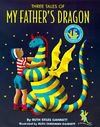 I liked the folktale (hero's journey) structure of the tale. It's told as something that happened to someone else (the narrator's father), in a (relatively) distant time, the hero goes on a quest, taking with him a bundle of objects that only prove their utility in unexpected circumstances (as when lollipop-loving alligators make a bridge across a river when the boy attaches a lollipop to each alligator tail, the boy able to cross on the alligaors' backs as each 'gator licks the lollipop tied to the tail of the next), the boy is clever without being obnoxiously brilliant, and the dangers seem real (the wild animals have a taste for boys). I thought it would read aloud well. I recommended the book to children 6 to 11. It has a great beat, you can dance to it.
The question came up today, too. How did I answer?
The books I checked out were ones I'd picked from the lists of recommended books the librarians have drawn up. Bunnicula by James & Deborah Howe, My Father's Dragon by Ruth Gannett, Two Bad Bears in the Big City by Daniel Pinkwater (actually this is a sequel to the one the librarians had listed), The Not-Just-Anybody Family by Betsy Byars, and poet Donald Hall's Ox-Cart Man.
I read none of these as a child -- but then only two were available when I could have read them "as a child". Besides, there being so many interesting books I haven't read, I didn't consider rereading any (even if it's been decades since the first time).
I often find Hall's poetry dull but liked Ox-Cart Man for its simple details and slightly stiff (old fashioned?) structure. Hall wasn't in pronouncements mode the way so many a contemporary poet goes wrong; he was just saying, this is what the farmer & his family did and this is the order they did those things.
I enjoyed Betsy Byars' Not-Just-Anybody Family, though in a short book swinging back & forth between the distinct points of view of five characters in five different places I got a twinge of whiplash. I think the story only takes place over two days, but the boy whose legs got broken seems to wake up & fall asleep enough for three or four days.
Bunnicula was cute and a bit overly joshy. Still, gotta give 'em points for a vegetarian vampire.
I read a Daniel Pinkwater book every few years, just to keep up. He's a funny guy.
In the interview I only talked about My Father's Dragon, having taken it from the shelf partly because of the striking stripes on the dragon.
 I liked the folktale (hero's journey) structure of the tale. It's told as something that happened to someone else (the narrator's father), in a (relatively) distant time, the hero goes on a quest, taking with him a bundle of objects that only prove their utility in unexpected circumstances (as when lollipop-loving alligators make a bridge across a river when the boy attaches a lollipop to each alligator tail, the boy able to cross on the alligaors' backs as each 'gator licks the lollipop tied to the tail of the next), the boy is clever without being obnoxiously brilliant, and the dangers seem real (the wild animals have a taste for boys). I thought it would read aloud well. I recommended the book to children 6 to 11. It has a great beat, you can dance to it.
Tuesday, January 10, 2006
and
The interviews I discuss in the post below, by the way, were for a 15-hour a week job affixing RFID tags to items in the library's collection -- not the sort of task that requires (or invites?) intellectual engagement. So the answers to the book question probably made no difference one way or the other.
interview question
At Berkeley Public Library nearly every job interview includes the question, "Tell us about a book you've read recently that you enjoyed. Who would you recommend it to and why?"
What with my recent promotion I guess I'm of a high enough rank to join interview panels -- I was on one today. The two other people on the panel have been supervisors for years and years and have hired lots of staff. I think I was there more to gain experience myself (& to provide a warm body) than for my expertise in sussing out the great workers.
We interviewed five people. None of them did very well on the what've-you-read-lately question.
One actually said she was enjoying the work of a poet. Sadly, she blanked on the poet's name. "She lists nonsense syllables that, as you read them, make a musical sense." I made one guess at the poet's name, but didn't hit it.
Another, after biting her lips, said she'd been reading to her kids a lot lately and could recommend The Cat in the Hat. "It's fun to read," she said. "Last night my son kept telling me not to sing as I read."
Our youngest interview mentioned Guns, Germs, and Steel, but the best he could offer about it? "It reaffirmed a lot of my ideas." Nice! Which ideas were those?
One of the other members of the interview panel went off, after this candidate left, about how poorly written the book is. Curious, I quite liked it. I don't recall thinking it at all poorly written.
The Historian has "an engaging plot", said another candidate. I thought the title vaguely familiar so prodded, "Is it a thriller?" "I guess you could classify it that way," she said. "The hero chases Dracula around." Who would she recommend the book to? "Probably to my best friend."
The Screwtape Letters. When my brother and I read the Chronicles of Narnia as kids we got interested in C. S. Lewis. I remember David talking about reading The Screwtape Letters. What did our candidate say? Our candidate alluded to the subject being "theology" and (like the young man who liked Guns, Germs, and Steel) found it a good book for "starting discussions".
"None of them gave good reader's advisory," said one of the other panelists.
"What were these books about?" I said.
Saturday, January 07, 2006
Wicked
Gregory Maguire seems to have wanted to explore the nature of wickedness. So he wrote Wicked: the Life and Times of the Wicked Witch of the West. Contemplating the project I thought Maguire would use his novel to explain how the witch became wicked and, incidentally, explain other things, like why a pail of water melted her.
But it turns out Elphaba (the name Maguire gives "the Wicked Witch of the West", basing it on the initials of the author of the Wizard of Oz) is neither wicked nor a witch nor from the Winkie Country (Oz's western province). She did some things that could be construed as bad -- sicced a swarm of bees on a man, killing him (but the command seems to have been unconscious -- the bees did her will without her realizing it) and she neglected her child (she treats him like a stranger). Though, oddly, she seems to have been born with some evilesque characteristics -- like sharp teeth that make breastfeeding hazardous for Mom. She never studies witchcraft (though her sister, the WWotE, does) but powers seem to manifest nevertheless -- as when she races across a river to rescue a monkey and the river freezes under her feet, saving her from dampness -- but maybe this was coincidence, as even the text suggests, since if a river can freeze instantly why not a pathetic little pail of water? But, and this left me most dissatisfied, what was the basis of Elphaba's allergy to water? No explanation is ever offered -- other than it being inherent, I guess.
At least L. Frank Baum gives us this: "Once the Witch struck Toto a blow with her umbrella and the brave little dog flew at her and bit her leg in return. The Witch did not bleed where she was bitten, for she was so wicked that the blood in her had dried up many years before." One may decide that her dryness had become essential to her in some way. Thus the deadliness of a spot of water.
Though born in the Munchkin Country Elphaba ends up in the Winkie Country because that's where the father of her child lived. Elphaba is seeking forgiveness from her dead lover's widow (forgiveness for having seduced the husband). The widow seems uninclined to give it mainly because it's boring and lonely in Winkieland and if she forgives Elphaba the woman will go away and make Winkieland more boring & lonely than ever.
While Maguire's prose can be well-wrought the text is frequently grim. This is an Oz with a fascist ruler (the Wizard tortures people, has secret police); famine stalks the land; the weather kinda sucks; and amoral capitalists engage Elphaba in tiresome arguments about the nature of evil.
Friday, December 30, 2005
Dorianne Laux's breasts
As I read poetry I keep a stack of placemarks handy. If I read a poem I'd like to return to I pop in a placemark. If after repeated reading the poem remains one I don't wish to leave behind I hand copy it into a notebook.
I copied out three poems from Dorianne Laux's What We Carry, a book I bought when it was first out. I think part of the reason it took so long for me to get around to reading it was that I liked Dorianne's first book so much. I guess I was saving What We Carry for a special occasion. This fall I booked a few days in Calistoga, wanting to try a mud bath and get away from Berkeley. Kent often pines for a massage so I booked us two massages in three days.
Anyway, I brought along What We Carry and read it on a lounge chair on our room's private patio. We had a tiny triangular pond brimming with reeds and roses and blackberries and fresh tendrils of wisteria swooped down from the roof. I would read a few pages, then close my eyes.
And I liked What We Carry so much I decided, rather than mark particular poems for rereading, I would go back through the whole book.
When, about a month later, I picked it up again the poems had settled more and I started noticing where Laux would repeat herself, poem to poem, where she would soak in a warm theme, what she liked to talk about.
I note that all three of the poems I've copied into my notebook (& even a third I read several times before choosing not to copy) contain the word "breast". In the poem, "Aphasia", the woman who has lost the power of speech (but for one word) opens her blouse for her husband, "fumbling / at her buttons, her breasts, / holding them up to the light / like a gift."
In "Twelve" Laux describes herself (one presumes) and her friends secretly reviewing girlie magazines in the woods. I like the poem particularly for the motherly way one of the boys attends to his baby brother, retrieving the child's pacifier and cleaning it when it falls from his mouth. That alludes to breast anyway, but of course "the turning / of the pages began, ceremoniously exposing / thigh after thigh, breast after beautiful, / terrible breast ..."
And in "Late October" Laux late at night drives scrabbling, yowling cats from her driveway, "a broom handle slipping // from my hands, my breasts bare ..."
Monday, December 26, 2005
Saturday, December 24, 2005
gay marriage in 101 Dalmatians
When Mr. Dearly marries Mrs. Dearly (her maiden name is not given) they move into a house together with their dogs and the nannies they grew up with.
"Nanny Cook and Nanny Butler met and, after a few minutes of deep suspicion, took a great liking to each other. And they had a good laugh about their names.
"'What a pity we're not a real cook and butler,' said Nanny Cook.
"'Yes, that's what's needed now,' said Nanny Butler.
"And then they both together had the Great Idea: Nanny Cook would train to be a real cook, and Nanny Butler would train to be a real butler. They would start the very next day and be fully trained by the wedding.
"'But you'll have to be a parlourmaid, really,' said Nanny Cook.
"'Certainly not,' said Nanny Butler. 'I haven't the figure for it. I shall be a real butler -- and I shall valet Mr. Dearly, which will need no training as I've done it since the day he was born.'
"And so when the Dearlys and the Pongos [the dalmatians] got back from their joint honeymoon, there were Nanny Cook and Nanny Butler, fully trained, ready to welcome them into the little house facing Regent's Park.
"It came as something of a shock that Nanny Butler was wearing trousers.
"'Wouldn't a black dress with a nice frilly apron be better?' suggested Mrs. Dearly -- rather nervously, because Nanny Butler had never been her Nanny.
"'You can't be a butler without trousers,' said Nanny Butler firmly. 'But I'll get a frilly apron tomorrow. It will add a note of originality.'"
The first illustration of the book shows Mr & Mrs Dearly walking arm in arm, followed by the two dalmatian dogs with Nanny Butler & Nanny Cook bringing up the rear, Nanny Butler in her jacket with tails, striped trousers, and a frilly apron, her hair pulled into a bun, Nanny Cook in a dress, round glasses on her face which she turns to Nanny Butler. The chapter title, which seems to act as caption to the drawing: "THE HAPPY COUPLES"
Thursday, December 22, 2005
Annie Proulx's "Brokeback Mountain"
What with the opening of the movie version I figured I wouldn't be able to find Annie Proulx's short story in the library. The New Yorker, the magazine in which the story was originally published, briefly had it posted on their website but it looked long and I'm not much for reading long on the computer.
I searched the library catalog and discovered Still Wild, an anthology of short fiction set in the West edited by Larry McMurtry. McMurtry wrote the screenplay for Brokeback.
The story is a bit muckier than the glistening cleanliness of the movie, "The room stank of semen and smoke and sweat and whiskey ..." But there's not much that happens in the movie that isn't already in the story. Some scenes are fleshed out versions of the story's summaries. "[A] short dirty fight" is all the description Proulx gives but the movie has Ennis punching the driver of a pickup which has just avoided running him down, the driver getting out and putting in his own series of punches.
My favorite scene, where Jack & Ennis have been carrying on this semi-annual affair of the mountains for twenty years and they finally have an are-you-being-faithful-to-me moment, is in the story almost word for word what you hear in the theatre. When I said that to Kent he asked, "So what does Ennis say?"
Ennis, as depicted by Heath Ledger, is a mumblemouth. He's getting lots of critical praise for his performance. But I liked Jake Gyllenhaal's Jack better. Or maybe I just liked Jack and didn't like Ennis.
When Jack suggests they go to Mexico, somewhere not so damn cold as these mountains, Ennis gets suspicious. Maybe Jack has gotten same Mexico tail? Boys? "'I got a say this to you one time, Jack, and I ain't foolin'. What I don't know ... all them things I don't know could get you killed if I should come to know them."
"foolin'" and "killed" were, I think, the only words I caught in the theatre.
Nice to see Jack not put up with this shit. "'I'll say it just one time. Tell you what, we could a had a good life together, a fuckin real good life.'"
Subscribe to:
Posts (Atom)