from the diary: “Sunday 1/26/86
I dropped by to say hello and “Ninnah & Adam … invited me to The Kiss of the Spider Woman at the Plaza in Petaluma. I’d been wanting to see this for a long time cuz it has two men kiss – Raul Julia and William Hurt.
“The movie was absorbing. I really liked the interplay in the cell. The movie fantasies were funny. I was never bored. But Molina (William Hurt) annoyed me. He spouted some lines that sounded as if they’d been lifted from The Naked Civil Servant (the film of Quentin Crisp’s autobiography of the same name) about always looking for a real man but never being able to find him because even if he did the real man couldn’t love him because a real man could only love a woman. He said at one point (about his penis), ‘If I had any courage I’d cut it off.’ I made some comment about the first point to Ninnah during the movie and she said, ‘That’s the eternal homosexual dilemma.’ (meaning the desire to be female, I thought). I bristled but didn’t say anything.
“Later in the car we discussed the movie. I told them I thought Molina was too close to being a cliché and was too unrelentingly tragic – of course he had to die at the end, no faggot can ever be happy. Just another tragic misfit destined to come to a sorrowful end in a world where he can’t fit in. hmph. I enjoyed the movie until Molina left the cell, then I thought it became too much like one of Molina’s fantasies; slightly absurd and more than a little overdone. But the cell interaction was great. I love intimate conversations (like My Dinner with Andre). The close quarters, the two (or small number) interacting so you can feel their presence.
“But the kiss – I was knotted and nervous, my hands were cold, I got no jolt from it – the circumstances with Molina working for the authorities, Raul left to be tortured again.”
No, it’s not about a book. It’s about a movie. But it’s a more thoughtful response than most of the excerpts about books I’ve been posting.
Friday, June 16, 2006

Thursday, June 15, 2006
Original Sins
from the diary: “Saturday 1/25/86
“Lisa Paulick’s new (used) car had konked out on Huntley across … from our house. … This is the same Lisa who has dropped by the house – once with Becky, and just after Xmas with Becky and Jim. [Lisa] called her dad from someone else’s house. He showed up and Dad and Mom and me and the man who is fixing our roof (whose name I have forgotten; don’t I feel like a bourjour (how the fuck do you spell that) creep in the midst of reading Lisa Alther’s second novel, Original Sins, that I don’t even know his name – this guy Mom thinks is great, oh boodle) all stood around trying to figure out what to do. [Lisa’s] dad got the car going while I was in the house getting a pizza bagel.”
This is such a mess of a piece of writing I find it has odd charms. Oh boodle?
I remember liking Alther’s first novel Kinflicks. She wrote sex scenes I found hilarious. Plus there was much bisexuality going on.
I’m not going to try to unknot the personal relationships in this paragraph other than to say I went to high school with Lisa, Becky, and Jim. And “bourjour”? Did I mean bourgeois? If I did, what did I think “bourgeois” meant? I guess I was exploiting the working class. In that I wasn’t working. I haven’t gotten any better at diagnosing cars.
Wednesday, June 14, 2006
Poems from the Coffee Lands
This is a chapbook anthology of poems from eight countries; it’s about the dimensions of a postcard, 32 pages including bios, publication histories of the poems, small guidebook-pretty pictures and a contents page. Says the introduction, “These countries, whose soil, topography and climate combine to produce the world’s best coffee beans are also lands with a rich heritage of poetry. A coincidence?”
I picked up this little book a couple years ago, having stopped in at the Starbucks a half block from the library for my morning coffee and croissant. It was a freebie and maybe it came with a bag of beans or a tiny scoop or something, I don’t remember quite. The poetry isn’t bad. Yes, I was surprised not only that the poetry wasn’t bad but that it also wasn’t familiar, that I recognized only three of the fifteen poets (Octavio Paz, Jimmy Santiago Baca, and Ruben Dario), and that most of the poems are translations. No editor is credited, though a note on the back cover says, “Prepared by TidbitBooks.” A Google search returns nothing.
It did sit around awhile before I finally read it through. “garden detached / from any idyll / or atrocity” – Duda Machado (tr. R. Alfarano) … “the sky walked / from eye to eye” – Eunice Odio (tr. M. Collins)
Too bad they haven’t made this a regular thing. On the other hand, it’s now time for me to throw it away. Toujours gai!
Saturday, June 10, 2006
Famous Ghost Stories
from the diary: “Wednesday 1/20/86
“Finished the book on beauty and am on Famous Ghost Stories edited by Bennet Cerf.”
And I ask myself, “Is there something I should do before / for my twenty-first birthday?”
Like, maybe, come out?
“Finished the book on beauty and am on Famous Ghost Stories edited by Bennet Cerf.”
And I ask myself, “Is there something I should do before / for my twenty-first birthday?”
Like, maybe, come out?
Friday, June 09, 2006
Face Value: The Politics of Beauty
from the diary: “Saturday 1/18/86
“I’m reading another provocative book -- Face Value: The Politics of Beauty. The authors tend to raise more questions than they answer: What is beauty? What makes a woman beautiful? Is beauty quanitifiable? Why is beauty so important?
“They make a good case for the importance of the questions but so far they haven’t gone a long way toward answering them. But then, they point out, nobody else much has either.
“… Whenever I hear or read about beauty or even when shown beauty (all of this usually being feminine beauty) I (consciously or unconsciously) run beauty past my mind’s eye in masculine forms. Female beauty, while it interests me and sometimes delights me, doesn’t have the powerful emotional oomph of male beauty for me. And yet I can’t admit it in words – even to myself in a great number of cases. Nonverbally and in private I can gasp at gorgeous men but in public, to anyone else, I hide, cover up, qualify.”
Wednesday, June 07, 2006
The Nazi Extermination of Homosexuals
from the diary: “Friday 1/17/86
“Mom and I talked about the Nazis and how horrible they were (this prompted by a TV special I saw last night, photos of the Third Reich. ick) I threw caution to the wind (from the stinking furnace) and showed Mom a book I’d checked out from the Santa Rosa library. The Nazi Extermination of Homosexuals. She read the captions under a few pictures.
“This was some bit after Mom read an article in the latest West County News about school AIDS policy – including sex ed. – and Mom says, ‘Would that mean talking about … (anal sex)?’ She makes a face.”
“Mom, you hate sex back, front, and sideways. You’re probably (how can this not be true?) one of the reasons I’m so hung up about sex.”
Tuesday, June 06, 2006
men and lambs
So one of the books I’ve been reading, Of Men and Monsters, discusses The Silence of the Lambs rather extensively. The confluences with Jeffrey Dahmer both in rough time period and in characteristics of the kills were enough to catch one’s notice. Hannibal Lector in fiction is a killer and a cannibal. Buffalo Bill, the killer at large, whom FBI agent Clarice Starling hopes to catch, is queer – if not gay or transsexual, at least a transvestite. He likes to wear women’s clothing. He likes to wear, as I recall, women’s skin. Jeffrey Dahmer, the real life killer, became notorious both for being queer (he was gay) and for being a cannibal (he dismembered and claimed to have eaten at least a token quantity of the flesh of his victims).
Richard Tithecott’s Of Men and Monsters also talks about how society and the media view the serial killer. In some ways, he’s the hero. He’s just acting out what many, too repressed, bound by laws, dream to do. Hannibal the Cannibal is a hero, isn’t he? He’s virile (straight), athletic, and oh so scary. Movie scary. Almost one of those misunderstood monsters of yore – King Kong, you know, or the Frankenstein monster. Could Jeffrey Dahmer be a hero? Even though he’s queer? Just because we abhor, says Tithecott, it doesn’t mean we can’t also admire.
I avoided The Silence of the Lambs for years because I didn’t want to contribute my own little bit of financial reward to the reinforcement of the killer queer stereotype. That plus I don’t care for serial killer horror movies. I like monster movies. Like The Blob or Valley of Gwangi. Nonhuman menaces from other worlds. And I didn’t figure I’d ever read anything by the author of Silence of the Lambs. Only, I find I have. Black Sunday is also by Thomas Harris. The same Thomas Harris. Thirteen years separates Black Sunday and Silence of the Lambs. I wonder if femme in a boy equals evil in all his books?
Friday, June 02, 2006
pile of reading
Walden / Civil Disobedience by Henry David Thoreau
Poems for the Millennium: the University of California Book of Modern & Postmodern Poetry, Volume Two: From Postwar to Millennium, edited by Jerome Rothenberg & Pierre Joris
The Collected Poems, Sylvia Plath
The Long Walk to Freedom, the autobiography of Nelson Mandela
Swann’s Way by Marcel Proust, the C.K. Scott Montcrief translation
The Woman in the Shaman’s Body: Reclaiming the Feminine in Religion and Medicine by Barbara Tedlock, Ph.D.
Tropical Truth: a story of music and revolution in Brazil by Caetano Veloso
Queer Crips: Disabled Gay Men and Their Stories, edite by Bob Guter & John R. Killacky
How We Die: Reflection on Life’s Final Chapter by Sherwin B. Nuland
Of Men and Monsters: Jeffrey Dahmer and the Construction of the Serial Killer by Richard Tithecott
Pictopia #4, a Fantagraphics anthology of art comics
Drawn & Quarterly #5, a DQ anthology of art comics
a May 2005 issue of The New Yorker
Saturday, May 20, 2006
critique
After high school I was a member of a couple different writers’ groups. One was an offshoot of the Russian River Writers’ Guild readings. This group only met a few times. In my diary (1/13/86) I recorded a critique:
“Stan brought the same thing he brought last time. We picked at his grammar and construction, transitions and such, all the way through. Then I wrecked his punchline. The philosophy went something like this: You (the man in the story) will not have any new dreams until you have made real the dreams you have already had. I said, “There are two different kinds of dreams in this statement. The first is sleeping dreams that, it is made obvious from the preceding, the man cannot have. But the second is dream in the sense of wish or hope as in The dream of universal happiness. Peace on Earth. Love between peoples. etc. 'Why,' I asked, 'cannot the man have sleeping dreams? These two different types of dreams seem to me unrelated. Why can’t the man have sleeping dreams?' Stan couldn’t answer. He said that wrecked the whole thing. I don’t really think it did, but I leave that up to him.”
“Stan brought the same thing he brought last time. We picked at his grammar and construction, transitions and such, all the way through. Then I wrecked his punchline. The philosophy went something like this: You (the man in the story) will not have any new dreams until you have made real the dreams you have already had. I said, “There are two different kinds of dreams in this statement. The first is sleeping dreams that, it is made obvious from the preceding, the man cannot have. But the second is dream in the sense of wish or hope as in The dream of universal happiness. Peace on Earth. Love between peoples. etc. 'Why,' I asked, 'cannot the man have sleeping dreams? These two different types of dreams seem to me unrelated. Why can’t the man have sleeping dreams?' Stan couldn’t answer. He said that wrecked the whole thing. I don’t really think it did, but I leave that up to him.”
Friday, May 19, 2006
Black Sunday

from the diary: “Friday 1/10/86
“I find myself identifying a bit with the luny who plans to blow up the Superbowl. He has/had a rotten self-image, only able to see himself in short pants, a sissy. I can only see myself ‘fay’ with long hair I push behind my ears, long slim fingers, folded legs, swishing. And I don’t swish. Try to replace this image with reality. at least.”
The next day, “I did today what I do most every day, sat around and read … Black Sunday (which was an okay book, but for a thriller it didn’t produce enough thrills). Then I went for a walk.”
Ach! I was being so fastidious about the chronology of the diary. Then! Today's entry was written before the Mother Tongue entry. And I overlooked it when it came time to post. My development as a person is getting all confused!
The right metaphor?
I don’t really remember anything about Black Sunday other than what’s obvious from the cover or the poster for the movie – something about bombing the superbowl from a blimp. But reading the old diary entry I’m reminded of the killer transvestite in Freebie and the Bean. I remember rather rooting for her. Yeah, she was an evil queer but a kickass fighter – and she kicked ass in a dress. Who else was I going to root for? Freebie? The Bean?
Tuesday, May 16, 2006
Another Mother Tongue: Gay Words, Gay Worlds
from the diary: “Sunday 1/12/86
“Almost every time I read a particularly good book on theories/histories of human development – cultural, emotional, physical – little clicks go off in my head as the previous theories are checked against the one I’m now reading. Inadequacies are discovered, fallacies struck out, gaps filled or opened. And they subtly shift and change to accommodate one another. That’s delightful. I’m not chagrined that no one theory works perfectly to explain all behavior, all human characteristics, because no one person in one culture can see everything at once. What thrills me is that so much can be discovered beyond the taken-for-granted. Even the taken-for-granted casts new shadows in a different colored light.
“The latest good book -- Another Mother Tongue: Gay Words, Gay Worlds by Judy Grahn. This book is helping me transform the shame. I can’t say ‘I’m proud to be gay.’ Because I’m still closeted. Still terrified of myself and the world. But it helps to know that ‘gay’ is not an aberration or an accident, not a failing [that needs] to be corrected or cured, but an essential, integral part of the human being. Modern Western civilization views the world scientifically, morally, socially through its own set of skewed spectacles. Perhaps what we need is not a polishing of our glasses, a new prescription, or an operation on our corneas. What maybe we need is a taking off of our glasses so we can see ourselves as we really are. But then again there rises the question – Who are we? And who’s got the answer?”
We should close our eyes sometimes. Even when that makes it difficult to read a book.
I’d like to read this book again. I bought it a couple years ago. It’s sitting upstairs in the library waiting to be filed. We need more shelves.
Gay men are called faggots, says Grahn, not because they were as cord wood to be thrown on the pyre but because the word recalls the role of firecarrier, firebringer for the tribe. Lesbians have long been teachers, healers, warriors.
I was damn grateful for a book that told me I wasn’t a biological curiosity at best, an example of “social deviance”, but a person and valuable. Poet is a gay role. And Grahn gave me permission to own the role Poet as well as Gay man.
One of Judy Grahn’s poems is included in the Berkeley Poetry Walk and at a reading to celebrate the installation of the poetry panels I shook the woman’s hand and said, “Thank you. I read Another Mother Tongue at a time I really needed it.” And she bowed her head over my hand quietly then looked me in the face and smiled.
Saturday, May 13, 2006
The Ox-Bow Incident
from the diary: “Friday 1/10/86
“Read The Ox-Bow Incident. Books don’t affect me the same way as movies. If I’d watched the hangings in a movie the thing would still be haunting me. As it is I’m reading Black Sunday and Ox-Bow is fading.”
It disturbed me at the time but, consonant with what I said then, I barely remember The Ox-Bow Incident. Wasn’t it about a lynching?
On the other hand the visual of the two teen brothers hanged for rustling in the Clint Eastwood starrer Hang ‘Em High throws itself up on my mental movie screen every so often and does not fail to disturb. That at the beginning of the movie Eastwood himself is lowered from a tree where he has been strangling after a botched hanging adds something (brotherly? fatherly? erotic?) to Eastwood’s watching the execution. He’d argued for their lives.
Thursday, May 11, 2006
book buying
Wednesday I went to the gym, checked my mailbox (I could go on an Olivia cruise, subscribe to The Lambda Literary Report or send money to The Pacific Center; plus a card from my brother who is going to be in town Friday); I ate lunch at the Jazzschool café and wrote in my diary; then I browsed Half Price Books, mostly the clearance shelves. Surprisingly good shit turns up on their clearance shelves. I’ve even seen a buyer from one of Berkeley’s other used book stores filling up a basket at the Half Price clearance shelves. The books below (‘cept for the Dykes books which I paid more for) cost me a buck apiece:
Dykes to Watch Out For by Alison Bechdel
More Dykes to Watch Out For by Alison Bechdel
Celebrated Cases of Judge Dee: an authentic Eighteenth-Century Chiense detective novel translated and with an introduction by Robert Van Gulik
The Old Man in the Corner twelve mysteries by The Baroness Orczy
The Lost World by Arthur Conan Doyle
A Member of the Family: Gay Men Write About Their Families edited by John Preston
I do like poking around bookstores. The two mystery books are Dover editions and I have a fondness for Dover’s mission to rescue long out of print, public domain literature and make it available in sturdy editions. My first and favorite edition of The Wonderful Wizard of Oz was a Dover edition. That thing stuck together through several readings (& much travel).
I guess I buy books for comfort. I imagine all those cozy hours tumbling through their pages. Then, of course, it takes me ten million years to get around to reading them. The library is cheaper. Free! But when you’re spending a dollar or less for a book isn’t it almost free?
Wednesday, May 10, 2006
Rumblefish
from the diary: “Tuesday 1/7/86
“I been reading Rumblefish, my first S. E. Hinton, so her and me’s style’s getting screwed around together. Not doin’ neither of us justice excuse me.”
Pretty early I noted the effect a strong style would have on me. Shakespeare was the worst. If I read any Shakespeare I would but unable to write anything but execrable Shakespeare pastiche.
These days styles are pretty much a jumble in my head. I switch between them almost as fast as Robin Williams doing stand-up (or just an interview, have you seen that guy?). It’s one of the things I like about poetry. I have more leave to mix things up than I feel in prose. Writing prose I think I’m supposed to maintain a consistent voice. And the longer I gotta do that the less likely it goan hapn. Y’dig?
Every time I pass Hinton in the library’s Young Teen fiction section I tell myself, I’ll read one of her books someday. And it turns out that one day was ten years ago. Boy, that takes the pressure off. I wonder, if I saw the movie version of Rumblefish, would any of it seem familiar?
Monday, May 08, 2006
The Caves of Steel
Twenty years ago I was living with my mother. My brother had moved out. My father lived several states away. I was having “Anxiety Attacks” and feeling, as I say below, “trapped.”
from the diary: “Thursday 1/2/86
“I’m starting to read Asimov’s Robot novels starring Lije Bailey. Only a few chapters into the first [The Caves of Steel] and it strikes me as historical fiction – “This is what they thought the futue would be like back in the olden days. But we know better now.” I wonder what the third one [Robots of Dawn] will be like, being as it was only written a couple years ago. Well, science fiction dates, sometimes easier than mainstream fiction. Asimov, though, is always a quick read.”
A few days later: “Finished The Robots of Dawn. That was a good series. I particularly like the titles, The Caves of Steel, The Naked Sun.”
The diary goes on, “Slept late. Didn’t wake up till 12:30. Did I already say I decided I’m agoraphobic? That’s ‘fear of the marketplace.’ Asimov uses it as ‘fear of open places/spaces’ in the Bailey books … but my phobia seems more a performance one, except that it relates directly to the marketplace – I’m too terrified to ask anybody for a job.
“A lady was on Donahue some bit ago … defining phobias. [She] gave the profile of a phobic. ‘Bright, creative, perfectionist, etc.’ don’t remember the rest, but it all fit. Yes, yes, amateur diagnoser me. But I’m not a hypochondriac, I don’t tailor diseases to my symptoms. I’d thought about phobias before and thought they didn’t really bother me. But now I’m trapped. I can empathize with the woman on the show who’d been cooped up in her home 30 years. but shit. I wanna get unscrewed up much, much faster than that.”
Saturday, May 06, 2006
Dayna Macy
 So I was wandering around this afternoon with my camera. I don't do that much. When I'm walking with the camera I'm searching for a good photo. I see things that I like to look at but many times I know what I'm seeing won't end up a good photo. I posted a snap of an elephant carving over at LoveSettlement. Shortly after taking that I was walking through the new gourmet food court on Shattuck when a woman looked in my face and said, "I know you." She raised her finger, "Uh," she said, concentrating for the name. "Glenn," I supplied. "Wait," she said. "Not Craig. Glenn! That's it! You worked at Nolo! Do you still write poetry?"
Yes, I said. Google me. Lots of Glenn Ingersoll and it's just about all me.
I didn't remember her name. Dayna Macy. That's right. I remembered her. She was the woman who ran Nolo's PR. She also attended some of our afterwork yoga classes. As I recall she had good poses. Dayna has a website. But many of the internal links seem to be broken. One of the pages has links to writing, including this one in Yoga Journal about foraging in the East Bay parks. "When my foraging walk at Tilden comes to an end, I thank Muscat for a truly eye-opening day. My pockets are filled with chickweed and miner's lettuce, which I'll prepare for tonight's dinner. I head home, already tasting them, fresh and sweet."
My mother knew a few edible wild plants and miner's lettuce is one I learned from her. (Or maybe we both learned about it from one of her hiking buddies.) Whenever I go for a walk in the woods and see fresh leaves I pluck a couple and munch as I walk along.
Mom knew puffball mushrooms so I'll pick one if I see one and pop it in my mouth. There's such fear of poisonous mushrooms that whenever I've done this with someone around they gibber at me. There was a recent feature in the SF Chronicle about mushroom hunters. And another article in the East Bay Express covers the likelihood of getting ticketed for foraging in the East Bay parks; it's illegal.
Friday, May 05, 2006
Lost Girls
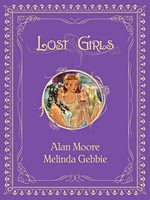
I like Alan Moore's work. I can't say as I quite love it. There's something a little Victorian curiosity case about it. He likes magic & mysticism. He has allowed eroticism into his mainstream comics writing in a way that feels adult rather than adolescent. He's always detailed and his work well crafted. A bit cluttered. A bit high strung. Kind of chilly.
As an Ozzy I'll have to say I'm feeling more trepidation than anticipation over Moore's forthcoming Lost Girls. Says the publisher, "For more than a century, Alice, Wendy and Dorothy have been our guides through the Wonderland, Neverland and Land of Oz of our childhoods. Now like us, these three lost girls have grown up and are ready to guide us again, this time through the realms of our sexual awakening and fulfillment."
Wednesday, May 03, 2006
Little Women
from the diary: “Thursday 1/2/86
“finished Little Women. Louisa May Alcott’s sweet preachments really got boring after awhile.”
Doesn’t everybody like Jo the best, Jo the tomboy? At least until she finds her Darcy … and becomes just another male appendage like her sisters.
The whole text is on the web if you sold your own at a garage sale.
Monday, May 01, 2006
Thomas M. Disch
Yes, the poet is also the science fiction writer. And he's gay. I think I thought there were two or three Thomas Disches out there.
But (wracking his brains) have I read anything by him? I'm pretty sure I've read a poem or two.
Judging by these, though, I can't say's Disch is my dish.
"How many moments make one slice of cake?"
But (wracking his brains) have I read anything by him? I'm pretty sure I've read a poem or two.
Judging by these, though, I can't say's Disch is my dish.
"How many moments make one slice of cake?"
Sunday, April 30, 2006
the poet Lynn Emmanuel says
“[F]or a writer to say in the year 2004 that she doesn’t want to know anything about critical theory is like a writer saying, in the 1930s and 40s, I’m just not going to read Freud.”
-- quoted in the Winter/Spring 2006 issue of Poetry Flash [no, the interview is not online]
I’m okay with knowing something about critical theory, I guess, but it would be nice if she defined the term. Despite the concreteness of her analogy (Freud!), “critical theory” is left vague. Emmanuel does not recommend a single critical theorist. In the sentence that comes just before this one Emmanuel refers to “the critical context in which [a poet is] writing.” Is “critical theory” the “context” of the poem?
I’ll have to say my tolerance for theory is low. And I figure the context of poetry is the times and other art. Not that theory can’t be part of that. Josh Corey’s blog, for instance, is worth visiting those evenings one needs a theory nightcap.
Friday, April 28, 2006
pile of reading
Harry Potter and the Half Blood Prince by J.K. Rowling
Tropical Truth: a story of music & revolution in Brazil by Caetano Veloso
Of Men and Monsters: Jeffrey Dahmer and the Construction of the Serial Killer by Richard Tithecott
Walden / Civil Disobedience by Henry David Thoreau
Swann’s Way by Marcel Proust
The Collected Poems, Sylvia Plath
Poems for the Millennium, vol 2: from Postwar to Millennium edited by Jerome Rothenberg & Pierre Joris
a May 2005 issue of The New Yorker
Compare to last month's pile.
Thursday, April 27, 2006
How to Stop Worrying and Start Living
From the diary: “Monday 12/9/85
“I’m down to two books from that pile of 30 I had mounted up. I’ve checked out new ones (and read some) since I achieved the goal – whittle the 30 to 5. … I started Carnegie’s How to Stop Worrying etc.”
The “pile of 30” refers to the number of books I had out from the library.
I worked my way through a few self-help books. I liked Dale Carnegie’s How to Stop Worrying and Start Living and How to Win Friends and Influence People. The advice is good. People like it when you remember their names, for instance. Politicians know this well. Clinton is famous for remembering personal details (& names!) of virtual strangers. Even dumbya gets a lot of points for his handing out of nicknames and remembering whether you have kids or that your mother is getting on in years.
I could pick up the principles for being popular but I could no more make myself a social animal through book learning than I could learn to speak German or Russian from poring over a textbook in my bedroom. To be good with people you need a lot of practice being good with people.
Wednesday, April 26, 2006
The Adventures of Huckleberry Finn
From the diary: “Thursday December Fifth 1985
“Finally reading The Adventures of Huckleberry Finn. And I like it. … And read a bunch of poetry. Gosh. There isn’t a lot of happy poetry being written I guess. Just when I’m about to give up on poetry as being incomprehensible I run across a few that are really wonderful. But why is that only about 10%?”
A couple days later I wrote, “Finished Finn. Didn’t live up to expectations and I do understand why some consider it racist.”
The “nigger” of “Nigger Jim” grated, but what do I know, right?, maybe “nigger” wasn’t really considered an insult at the time Twain wrote Huckleberry Finn. Maybe? But it was hard to have any respect for Nigger Jim, anyway. Twain had him childlike and loyal, certain that the boy Finn always knew what was best. Nigger Jim, as I recall, never had an independent thought and it was up to Finn to prevent Jim from just giving up and turning himself in.
I like Mark Twain. But he was racist. Big surprise! The racism of his time was so casual, so taken for granted that questioning it was like saying water doesn’t run downhill. In his account of travel to Lake Tahoe in California Twain has nothing good to say about the people native to the area. He calls them “diggers” and speaks with contempt of their dirtiness and poverty. Twain can be quite funny and is often ready to lampoon the arrogant and scoff at unexamined attitudes but it doesn’t mean that he was always ready to poke himself.
Monday, April 24, 2006
The Descent of Woman
Both The Naked Ape and The Descent of Woman helped me get my head out of the man-as-pinnacle of evolution/created-in-God’s image conflation.
From the diary: “Sunday December 1, 1985
“Am reading The Descent of Woman by Elaine Morgan. Great book. Great sequel to The Naked Ape -- it refutes a lot of Desmond Morris’ sex constructions – breasts [are] for babies to hold onto instead of fur [our ancestors having lost their fur, rather than the] pseudobuttocks [intended to redirect sexual attention from the behind to the upfront that Desmond Morris suggests].
“I started to tell Mom about some of this and she had to know first what the woman’s qualifications were. Her first reaction wasn’t, as mine would be, ‘Oh, what do they say?’ but ‘Oh, what gives them the right to say that?’”
This diary entry comes before the one that refers to The Color Purple. Same argument?
Saturday, April 22, 2006
The Uses of Enchantment
A few days ago when I began quoting from the old diary again I quoted from a page where a bookmark was resting. For some months I’ve been composing directly in the blogger box. But up to last fall I’d carefully written everything in a Word file because, you know, blogger used to lose stuff. Now that my mind is clearing and I’m feeling up to looking to the long term I am once more saving everything into that Word file and what do I find but diary-quotings I’d prepared and never posted.
So, what the heck, here’s the 20 years ago me reading a famous psychoanalyst:
From the diary: “Saturday November 30, 1985
“I’ve been reading a book called The Uses of Enchantment about how fairy tales provide essential pschological material to children so they can grow to become productive, mature adults – ‘live happily ever after.’ And I think I’m learning something, but I’m also getting anxiety attacks. I feel so overwhelmed by the attempt to understand myself. I want to retreat. I’m lost and confused and I hate it.”
A few days later I wrote, “Been really bogged down in Bruno Bettelheim’s The Uses of Enchantment. Been boring me for days.”
The wikipedia entry on Bruno Bettelheim is decidedly unflattering. It declares Bettelheim’s theories on autism “erroneous” and says he was a plagiarist, calling him “Bruno Borrowheim”. Yow. Who knew?
Friday, April 21, 2006
The Circle J
In an article, "Historic Circle J club closing", that appeared in a November issue of the Bay Area Reporter:
"Unlike sex clubs ... the Circle J's primarily hands-off code of conduct is a rarity, and 'the people who come here don't come here to have sex. They won't let you touch them. They're exhibitionists, or they like to watch. We've never had word of mouth because nobody would tell their friends where it's at. It's their place and they don't want the company of people they know.'"
The article describes the room: "[S]ome of the same clients from 35 years ago sit in one of seven church pews lined up in a small room with a large movie screen. On a recent afternoon most pews had one guy in it, pants unbuttoned to the waist, sitting and staring straight ahead, jacking off in close quarters barely making a sound."
"Circle J will be taken over by a neighboring church organization ... [Youth With a Mission] simply offered the landlord more money."
Thursday, April 20, 2006
Bats at the laundomat
Bats at the Laundromat is the title I gave the poetry notebook I was working in at the time. That would be late 1985.
Wednesday, April 19, 2006
The Enchanted Apples of Oz
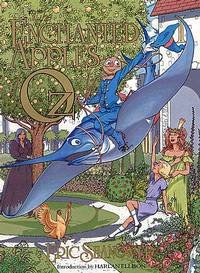
From the diary, Friday, 12/27/85 ...
"Eric S[hanower] showed me galleys of Enchanted Apples of Oz. They looked good. He wanted to know if I could accept it as canon. No. I can't. I can't lie and say, 'yes! oh yes!'"
This from an entry about visiting Eric at his house in Novato. We were Oz club chums and both had strong notions about what constituted an Oz book. A real Oz book. I'm not nearly so dogmatic as I once was. Hell, I knew at the time there were a zillion inconsistencies in the books written by Baum himself, but there were inconsistencies and there were unacceptable inconsistencies. In his first Oz graphic novel Eric locates the source of Oz's enchantment in an apple tree in a garden (tres Biblical, no?). Should the apples ever be picked the magic will go away. I didn't like the idea, tho Eric's art was exciting.
We watched Midnight Cowboy, which depressed me (or, rather, didn't improve my already low mood); ate pancakes for dinner; I fended off the what-are-you-going-to-do-with-your-life questions.
Gah. Miserable period.
Tuesday, April 18, 2006
Some Angels Wear Black
When I was at APE I saw Jennifer Joseph at the table for her Manic D Press. We dedicated the proceeds of a night at Poetry & Pizza to, as I termed it, the Eli Coppola Publication Fund. Eli was a poet much admired in the SF poetry scene of the 80s-90s. She died in 2000. Plans were in the works to publish a selected poems. After the P&P reading, which was partly a tribute to Eli with others reading her words, Jennifer Joseph said she would let us know when the book appeared.
Among other things at APE I asked Ms J what had happened with the Coppola book. "Oh! Didn't we send you a copy?"
I shook my head. J had me write down my address and the book arrived today. Some Angels Wear Black: selected poems. How neat. Flames all over the cover. A backwards question mark of a plant stem ... it's not a fern, are those leaves or flowers along the stem?
I was surprised to discover my name in the "publisher wishes to thank" paragraph on the copyright page. Jennifer includes me and my P&P mates, Clive, Katharine & Paul.
Saturday, April 15, 2006
AMAIOGIG
From Kimberly C. Patton's "Seas of Light Swept Through It", an essay included in Best Spiritual Writing 1998:
"[S]houted one older male [colleague] as our two large classes exchanged the lecture hall[,] 'I hear you have something in your belly!" At a faculty Christmas party: 'Bun in the oven, huh?' ... 'Why do these reactions bother me ...' I asked a dear friend ... who is devoutly Jewish. 'Am I hypersensitive?' ... He thought for a minute. 'Because they trivialize the mystery.'"
On the previous page Patton describes the awe she felt seeing the first ultrasound pictures of her fetus. Picking up some of the words she uses I wonder if Patton would have felt exalted by a colleague coming up to her in the crowded hall and exclaiming, "I hear you have 'a miniature, animate icon of God's incarnate glory' in your belly!"
Wednesday, April 12, 2006
did you like it?
I decided to go find a poem on the web and read it and say whether I liked it.
a poem by Tonnus Oosterhoff
Have you read it yet? You don't have to. I didn't like it. But maybe it's the translation.
I liked this line: "a wheelbarrow lull lull"
a poem by Tonnus Oosterhoff
Have you read it yet? You don't have to. I didn't like it. But maybe it's the translation.
I liked this line: "a wheelbarrow lull lull"
Sunday, April 09, 2006
What I bought at APE
Kent's been suffering with a cold/flu thing. The same one that had me down? Sure. Probably.
So today I went over to the Alternative Press Expo by myself. It was at the Concourse Exhibition Center in San Francisco.
I've just emptied my bag of goodies on the floor. A lot of freebies -- comics, postcards, a poster, business cards. I decided to allow myself a bigger budget than usual. This is what I bought:
Strugglers and Cavalcade of Boys, vol 3 by Tim Fish
True Travel Tales, issues 1 & 2, by Justin Hall
Grand Gestures by Robert Ullman
Don't Be a Crotte!, starring bi-dyke Liliane, by Leanne Franson
Hats by Vasilis Lolos
Brown Paper Bag, issues 1 & 2, an anthology of comics by Jonathan Hill, Tyler Owings, and Jason Rainey
Friends, issue 3, by Francois Vigneault
Little Scrowlie, issue 13, by Jen Feinberg & Todd Meister
The Far Shore, The Milkmaid, The Den of Sin, three mini-comics by Tim Swope
And Then One Day, issue 4, a mini-comic by Ryan Claytor
The Homeless Channel, issues 1 & 2, by Matt Silady
... I talked to several of the creators, not that I'm much at shootin' the shit, and got a sketch or two ...
Saturday, April 08, 2006
paperbacks
One of my new duties at the Claremont Branch is maintaining the collection of uncataloged paperbacks. This is a purely browsing collection. When I say "uncataloged" I mean you cannot find any of these books by looking them up in the library catalog. Should you check one out glance at the check-out receipt; the receipt will not list the title of the book, rather it will say your "paperback" is due on such-and-such a date.
Four years ago when I was putting in 15-20 hours a week at North Branch substituting for someone who, I think, was off on a several month sabbatical, I watched over the paperbacks for awhile. The mass market paperbacks, the thrillers and not-quite-formula romances and family dramas circulated like mad. I remember one lady bringing back a grocery bag filled with slightly cigarette scented paperbacks she'd plowed through. The trade paperbacks had half the circs.
I've been weeding the paperback collection at Claremont, getting rid of the stain-rumpled, underlined, and cover-loosened copies. At North I recall the turnover was pretty ruthless. The paperback had a year. At the end of the year you discarded it. If the condition was decent the book was put on the Friends of the Library sale shelf to sell for a big quarter. I don't know if it's just that it's been no one's steady duty but the paperbacks at Claremont have been allowed to age. One I deleted this week has been doing its rounds since 1995. I've deleted none whose tour has been so brief as one year.
Now that the RFID tag makes it harder to remove a book from the collection in presentable condition (y'gotta tear the thing out) most of the deleted books have their covers yanked off and get dumped in recycle. I'm realizing doing this where patrons can see the process is likely not a good idea. It's been convenient to do it at the Info Desk when things are slow but ... very public. Some people get tetchy over seeing books thrown in the trash.
Judging by my review of the circulation statistics of the books I discard I'd say the users of the Claremont Branch have different reading habits than those who visit the North Branch. A trade paperback (which tends to be more literature-like) would have twice the circs of a mass market paperback. When I was scanning the donations for candidates to add to the collection I'd been looking with most interest at the mass markets. I'll shift my attention.
Friday, April 07, 2006
thank you note
I've been reading Marguerite Duras's The Lover about a young French woman coming of age in Saigon. I picked up the book from a used bookstore clearance shelf. Neatly folded and stowed in the back of the book is the following note:
Derek (& tell Sylvia)
This book is like a calm quiet Tidal Wave! What realistic beautiful power must dwell in Marguerite Duras. I was moved to tears many times. I shall never forget it. Thanks for sharing.
Mom
Derek (& tell Sylvia)
This book is like a calm quiet Tidal Wave! What realistic beautiful power must dwell in Marguerite Duras. I was moved to tears many times. I shall never forget it. Thanks for sharing.
Mom
Wednesday, April 05, 2006
Beeswax
I stacked up all the issues of The New Yorker from my subscription. The stack is by the bed. I'm a little surprised to find myself enjoying working my way through them. With books I feel bound to push through from page one to page last. There are books I've been reading for years ... Walden, for example, recently rejoined my active reading pile but I probably only get through 3 of its pages each week. I'm about halfway. Magazines, however, are much more a miscellany. Frankly, there's many an article the subject of which just does not interest me. Sports teams, most humor ... I like funny but I don't seem to have much taste for humor.
I don't currently have any magazine subscriptions going but a new issue of something will make it into the house now & then. When I've read it, do I discard it? With The New Yorkers I've decided yes. Finish the issue, stuff it in the recycle bag.
I used to buy a literary magazine or two a month. But they piled up. I would read a few poems then put the issue aside and forget what if anything I'd read in it. But I do have a soft spot for the locals.
A couple days ago I bought the first issue of a new litmag out of Oakland, Beeswax. The cover is letter press -- means you can feel the impression of the print in the paper. A honey bee. Simple and friendly. At five dollars it's pretty cheap. There's no masthead. Only an invitation to address correspondence to "the editors" ... no email. Though there is a website address and there the editors name themselves. John Peck and Laureen Shifley. I wonder why they neglect the credit in the physical magazine? They include their own work in the first issue. None of the poets/fictionists/visual artists on the contents page are names I recognize.
I'm up to page 15. So far the work is competent. Short stories in litmags are usually not of much interest. I've given myself permission to skip over them. Nicole Ankowski's "It's Called Dancing" is a relationship dance. Rather slow moving but there are nice turns of phrase. "I wondered if a tattoo needle felt like teeth on skin, a mechanical ferret nipping over my chest." I might make it to the story's end.
The poetry so far is unobjectionable. I like that the editors like comics; it was one of the reasons I bought.
When the clerk was ringing up the purchase he made a comment about it being the first issue. "Number one?" he said. "An auspicious number."
Monday, April 03, 2006
The Color Purple
I haven't excerpted from my diary in a long time. Here's an entry dated 12/20/85. I was twenty. Mom was 63.
"Mom doesn't go in for fiction. It seems she literally can't understand the distinctions and accept the conventions of fiction. She laments and curses 'serious' dramas for 'oh they wouldn't really act like that' or 'so-and-so isn't a very good actor.' I don't think she is very qualified to pass judgment on acting ability.
"I went to The Color Purple. It opened in Santa Rosa today. Mom dropped me off on the way to a [substitute teaching] job. I took the bus home. I made the mistake of telling her a little about it when she got home from square dancing. She was instantly on the attack. I mentioned, just commenting on an observation, that the word 'nigger' is not used once in the film. Mom frowned, 'But they would've.' Fuck, so what? So it's a little revisionist. It worked.
"All right. Maybe I've exorcised some of the anger. [I've deleted some cursing.] I keep forgetting that I can't discuss movies and novels, in fact most of the stuff I read and see, with Mom. Documentaries are generally okay. Cuz then she can watch 'em for herself, I guess. Anyway -- I really enjoyed The Color Purple. My only real complaint is that both book and movie are a little too manipulative. But with that reservation I am glad to say I shed tears about three times during the film. I cried at the end of the book, too.
"... It's so frustrating. I can't seem to make Mom understand what I mean when I talk about -- The Color Purple, f'rinstance. And she gets so defensive. She said when she sees a movie filled with black faces she assumes the movie is a chronicle about what black people are like. I said, I don't. I see them as people first. She got a sorta fierce expression on her face and didn't seem to consider her position at all silly."
Saturday, March 25, 2006
pile of reading
The Martians, a collection of short stories by Kim Stanley Robinson, his follow-up to the Mars trilogy
A Scanner Darkly, a novel by Philip K. Dick
Walden / Civil Disobedience by Thoreau
Of Men and Monsters, an exploration of the role of the serial killer in contemporary America by Richard Tithecott
The X-Men, a reprint of the first ten issues by Stan Lee and Jack Kirby
Choteau Creek, a "Sioux reminiscence" by Joseph Iron Eye Dudley
8 Men and a Duck, "an improbable voyage by reed boat to Easter Island" by Nick Thorpe
Bitter Fame: a life of Sylvia Plath by Anne Stevenson
The Collected Poems by Sylvia Plath
American Elf: the collected sketchbook diaries of James Kochalka, 1998-2003
The Best Spiritual Writing 1998, edited by Philip Zaleski
an issue of The New Yorker from March 2005
diary
poetry notebook
I last listed my pile of reading about a month ago. You might note that there are books that are still in the pile. I've moved some pages forward in each but even with my new parttime schedule I'm not devoting a big chunk of my new time to reading. I'm a slow reader in any case. I like to hear the voice of the text.
Friday, March 17, 2006
American Elf
I've started reading the fat volume of James Kochalka's sketchbook diaries, Oct 98 - Dec 03. I remember reading somewhere a collection of the diaries he drew around the time of the 9/11 attacks.
"Each day I pick," Kochalka says in a drawn introduction, "one of [the little things that happened that day] and draw a comic strip about it. ... The days go by, the pages fill up, and the row of black sketchbooks grows on my shelf."
He draws himself as a big-eared, buck-toothed elf because, he says, "it reflects my relationship with the world. The magic & mystery of life and my awkward grappling with it." The strips are typically 3 to 4 panels, presented in a square. Kochalka doesn't try to tell a joke, does not necessarily go for a unity of effect. In the strip for Nov 18, 1998, for instance, the first panel depicts elf walking through melting snow, the caption, "All around me, sounds of melting snow" and word balloons within the panel cry out, "Gurgle" and "pitter patter" ... the day's other two panels show elf tapping away at a laptop computer. He glances askance at the reader, "Email is boring."
I find the dailiness of these charming.
Today at my new branch library gig Karen (my new boss) said to me she was working on a Christmas story but was dissatisfied with it because there wasn't any conflict in it. Her story was about a real Christmas, one that sticks with her because it came not long after her parents died and she spent the time with, I think, her sister & husband. She was trying to apply to her personal tale advice she's read in books on how to write.
There are different kinds of writing. Even if Karen succeeded in producing something commercially salable, it does not mean therefore she had produced something that would please her audience, for her audience is family and friends. And some of those people would be pleased by her writing because it included them and what happened happened to them and to people they love. Should the group of them walk into a bookstore together would they all agree on what book to buy? Surely not. One would go for racy romance, one for hard SF, one for experimental poetry, and one would quickly get bored and bow out for a cup of coffee.
Unless you're a staff writer or a freelancer whose bills will go unpaid without the sales of the ancillary rights, when you write you write for yourself first. You are your audience. And usually your worst critic.
I've been reading Anne Stevenson's biography of Sylvia Plath and Stevenson quotes from Plath's diaries many times. Plath was ambitious, determined, and methodical about marketing her work. She gnashed her teeth over rejection, probably dropped to darker depths over them than most of us can handle, yet she kept putting her work out there because that was damned important to her. She did not, however, write the diaries for publication. Much of what she did write for publication included scenes and details from her daily life and the lives of her loved ones and the result could be brutal, lacerating, and cruel. Full of conflict, mostly figurative but sometimes literal.
You can read today's American Elf here.
Tuesday, March 14, 2006
rewards
I was going to reward myself for a successful first day at Claremont by checking out books. Go figure! I'd put aside  Elmer and the Dragon, Alan Alda's recent memoir Never Have Your Dog Stuffed, and Craig Thompson's European travelogue in sketchbook/comic book form Carnet de Voyage. But then the computers went on the blink and were down more than up for most of the afternoon. When closing time rolled around I returned the books to the sorting trucks. They'll be there another time. It's OK. And I have books piled up here at home anyway.
 Elmer and the Dragon, Alan Alda's recent memoir Never Have Your Dog Stuffed, and Craig Thompson's European travelogue in sketchbook/comic book form Carnet de Voyage. But then the computers went on the blink and were down more than up for most of the afternoon. When closing time rolled around I returned the books to the sorting trucks. They'll be there another time. It's OK. And I have books piled up here at home anyway.
Sunday, March 12, 2006
The Best Poems of 2005
I got a note from Val Gerstle, one of the poets whose poem I'd included in my list of the Best Poems of 2004. She thanked me for liking her poem.
Since I haven't yet posted my favorite poems of 2005 I might as well do that now. The list is in the order I copied them out. I won't bother mentioning where I found them. Usually it was an anthology. A poet's own collection. Occasionally a magazine. I don't think there were any last year that I discovered on the web. They are listed in the order in which I found them.
Oni Buchanan ... "The Walk"
Kenneth Koch ... selections from "The Man"
Al Young ... "Third Street Promenade"
Gary Rosenthal ... "Ghetto Dokusan"
Tassajara Zen Center ... parking a car gatha
Lawson Fusao Inada ... "A Nice Place"
Czeslaw Milosz ... "Gift"
Leslie Scalapino ... poem beginning "A man getting on a bus..."
Dale Jensen ... "A New Ring"
Albert Goldbarth ... "The Bar Cliche"
Marcelin Pleynet ... "The New Republic"
Philippe Soupault ... "Sporting Goods"
Dave Etter ... "Bueno"
Nezahualcoyotl ... "Can it be true that one lives..."
Anonymous (Korean) ... "Wind Last Night Blew Down"
Allen Ginsberg ... "On Neal's Ashes"
Dorianne Laux ... "Late October"
Dorianne Laux ... "Aphasia"
Dorianne Laux ... "Twelve"
Kirmen Uribe ... "Notes on a Loose Piece of Paper"
Saturday, March 11, 2006
which book should I read to the first graders?
I volunteered to read to a classroom of kids on Drop Everything And Read (DEAR) Day. That'll be this Tuesday. Have I ever read to a group of kids before? Hmmm. Nope. Guess not.
Last Thursday the Children's librarians had a workshop on choosing a book. They spread lots of their favorite read-alouds across the tables in the Children's Services Room. And gave a little demonstration on how to read and when to turn a page.
I took five books home. Which should I read?
And Tango Makes Three by Justin Richardson & Peter Parnell, illustrated by Henry Cole
The Eye of the Needle a Yupik Eskimo tale by Betty Huffman, retold & illustrated by Teri Sloat
Traveling Man: the journey of Ibn Battuta, 1325-1354 by James Rumford
The True Story of the 3 Little Pigs by A. Wolf as told to Jon Scieszka, illustrated by Lane Smith
CLICK, CLACK, MOO: Cows that type by Doreen Cronin, pictures by Betsy Lewin
Possible problem with the last one: having to explain to the kids what a typewriter is.
Leaning toward Tango, the story of the gay penguins that raised a penguin chick in the Central Park zoo, and Needle, because it's a book my mother owned, I think she got it from Teri Sloat herself, and because I was born in Alaska and interviewed a Yupik dancer/storyteller for a school project. I read Tango to Kent. He teared up. Me, too.
Monday, February 27, 2006
pile of reading
diary
poetry notebook
The M Word: writers on same-sex marriage
The Best Spiritual Writing 1998
issue of The New Yorker from 2005
A Scanner Darkly by Philip K. Dick
The Best American Poetry 2005, guest editor Paul Muldoon, series editor David Lehman
Ox-cart Man by Donald Hall
my booklog which was supposed to / may someday provide the source material for this blog
The Martians by Kim Stanley Robinson
Choteau Creek by Dudley
Song of Rita Joe: autobiography of a Mikmak poet by Rita Joe
Walden / Civil Disobedience by Thoreau
Bitter Fame: a life of Sylvia Plath by Anne Stevenson
Fadeout by Joseph Hansen
World Poetry edited by Washburn, Major, Fadiman
The X-Men, nos 1-10, a volume in the Marvel Masterworks reprint series
Saturday, February 25, 2006
The Tedlocks
Dennis Tedlock and his wife Barbara Tedlock came to Black Oak Books last week. They both have new books. Dennis's is a translation of the Rabinal Achi, a Mayan text for performance. Not much Mayan literature survived the book burnings of the Spanish priests. The Rabinal Achi is a play depicting a sort of trial, said Dennis. A nobleman whose city & family have been traditional allies of the City of Rabinal has been captured. He led enemy armies against Rabinal and the trial is a dialog between him and his disappointed captors. Eventually the traitor is executed. "Europeans want him 'sacrified' by having his heart cut out," said Dennis. "That was the Aztecs. The Mayans typically used decapitation. Europeans don't find that exotic enough. Decapitation is too ordinary, too European. Capital punishment, after all, means cutting off the head."
Dennis spoke softly with many vocal pauses (uh, um), presented as the quiet academic, sincere and so full of knowledge that he couldn't say one thing without having to lead up to it from two or three directions.
Although I was very interested in what he was saying I found myself getting sleepy. Barbara Tedlock was much more dynamic, her excitement & delight bubbling out in her voice and gestures. Last year she published a book on women shamans, even finding out in her research that sources that had been represented in previous works as examples of male shamanism actually referred to women.
I'd planned only to buy the Mayan book but ended up getting both. Rabinal Achi: a Mayan Drama of War and Sacrifice by Dennis Tedlock, 2003, Oxford University Press. The Woman in the Shaman's Body: Reclaiming the Feminine in Religion and Medicine by Barbara Tedlock, 2005, Bantam Dell/Random House.
Afterward I got both authors to sign their books. Both also dated them. The date was the first day of the Mayan New Year, 7 deer / 7 kiej.
In his presentation Dennis said last year was a wind year, which is a difficult year. This year ought to be a little bit better.
Friday, February 03, 2006
Best American
So the Best American Poetry series is not published by Houghton Mifflin, the publisher of Best American Short Stories, among other Bests. BAP is so obviously modeled after the 80s revival of BASS, when BASS instituted a series of guest editors after its longtime editor retired/died (although there remained a series editor who would lighten the burden for each year's famous author/guest editor). It was with BAP's success that Houghton Mifflin realized what a good brand they had going ... and by the late 90s they had started annuals for spiritual writing and science writing and sports writing.
I like the idea of these anthologies. One wants a convenient sampler of recent words. And now one can refine the choice to words on a certain thing. I worked my way through several BASS anthologies back in the 80s (plus some O. Henry Award annuals). When I discovered BAP in its second year I was thrilled as I had very little access to literary magazines in Sebastopol and there was no such thing as the internet. Here was my opportunity to read what was being written NOW. Being a baby poet I wanted to see who my contemporaries (or contemporary elders) were.
I don't think, even then, I was buying the notion that what was contained between any particular Best's covers was objectively the BEST poetry (or whatever) that had seen print that year. I did like the notion that I was being exposed to what that year's famous poet thought great. I've found poems I like in BAP. And poems I don't. BAPs are better than any single issue of your average literary magazine. And you get to know the well-published names.
Houghton Mifflin even registered Best American as a brand. I guess they didn't think of it till after BAP was a going concern at another house. But to anyone who rails about the imprimatur of Best that these anthologies confer I say only: Best American Nonrequired Reading?
Tuesday, January 24, 2006
Cook's Illustrated
My sister gave us a subscription to Cook's Illustrated. Kent has said how he enjoys watching the PBS series, America's Test Kitchen, which is produced by the same people.
We got our first issue last week. Kent made use of one of the magazine's suggestions when he was making soup last night. When he added an egg he first mixed some corn starch with the egg. "Adding just 1/2 teaspoon of cornstarch to the egg that's drizzled into the soup at the end of cooking seemed to have a tenderizing effect," says a sidebar to an article on making hot & sour soup.
The nerdiness of America's Test Kitchen is more appealing on TV than in print. Whenever they make something they always wonder if they're using the best utensil for the job, or the best brand of vinegar, or whether the casserole cooks better on the upper shelf or lower shelf of the oven, or whatever. So they get together the different brands and test them. You want your bundt cake to fall easily out of the mold? There are spray on nonstick coatings that work better than the others (Pam for Baking and Baker's Joy). They put together panels of tasters who sip gallons of vinegars. Or they cook 18 casseroles, 3 on the top shelf front, 3 on the top shelf back, 3 on the middle shelf front, 3 on the middle shelf middle, and so on. It's like Consumer Reports devoted to cooking. The only color photos are on the cover. Gourmet this is not.
"In barbecue circles, the fat cap is almost always left face up, and many recipes repeat the same admonition when the meat is destined for the oven. But does it matter?" The short answer: Yes. The long answer: Three paragraphs. They cooked two briskets, one with fat on top, one with fat on bottom then compared. The fat, by melting over the meat, sealed in moisture.
Sunday, January 22, 2006
where you're coming from
I added a new utility to my links column (on the right), "Web pages referring to this page". I've seen it on Avoiding the Muse and Dale gets lots & lots of referrals. The referrals utility has been up since last week and so far the only referral it's recorded is the one I did as a test.
I had a referrals utility before (which I'd also picked up from AtM) and I'd always been dubious about its statistics -- was I really getting 90 referrals a day from LoveSettlement (my other blog)? The new referrals utility seems not to agree with the old one. But are no search engines leading people here?
2/3/06 update: I deleted the referring links utility.
Wednesday, January 18, 2006
interview question II
In prep for an interview for a position in Children's Services I checked out a handful of books. The interview was today. Last week I was on an interview panel myself and on this blog talked about the answers candidates gave to the What've-you-read-lately question.
The question came up today, too. How did I answer?
The books I checked out were ones I'd picked from the lists of recommended books the librarians have drawn up. Bunnicula by James & Deborah Howe, My Father's Dragon by Ruth Gannett, Two Bad Bears in the Big City by Daniel Pinkwater (actually this is a sequel to the one the librarians had listed), The Not-Just-Anybody Family by Betsy Byars, and poet Donald Hall's Ox-Cart Man.
I read none of these as a child -- but then only two were available when I could have read them "as a child". Besides, there being so many interesting books I haven't read, I didn't consider rereading any (even if it's been decades since the first time).
I often find Hall's poetry dull but liked Ox-Cart Man for its simple details and slightly stiff (old fashioned?) structure. Hall wasn't in pronouncements mode the way so many a contemporary poet goes wrong; he was just saying, this is what the farmer & his family did and this is the order they did those things.
I enjoyed Betsy Byars' Not-Just-Anybody Family, though in a short book swinging back & forth between the distinct points of view of five characters in five different places I got a twinge of whiplash. I think the story only takes place over two days, but the boy whose legs got broken seems to wake up & fall asleep enough for three or four days.
Bunnicula was cute and a bit overly joshy. Still, gotta give 'em points for a vegetarian vampire.
I read a Daniel Pinkwater book every few years, just to keep up. He's a funny guy.
In the interview I only talked about My Father's Dragon, having taken it from the shelf partly because of the striking stripes on the dragon.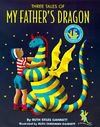 I liked the folktale (hero's journey) structure of the tale. It's told as something that happened to someone else (the narrator's father), in a (relatively) distant time, the hero goes on a quest, taking with him a bundle of objects that only prove their utility in unexpected circumstances (as when lollipop-loving alligators make a bridge across a river when the boy attaches a lollipop to each alligator tail, the boy able to cross on the alligaors' backs as each 'gator licks the lollipop tied to the tail of the next), the boy is clever without being obnoxiously brilliant, and the dangers seem real (the wild animals have a taste for boys). I thought it would read aloud well. I recommended the book to children 6 to 11. It has a great beat, you can dance to it.
The question came up today, too. How did I answer?
The books I checked out were ones I'd picked from the lists of recommended books the librarians have drawn up. Bunnicula by James & Deborah Howe, My Father's Dragon by Ruth Gannett, Two Bad Bears in the Big City by Daniel Pinkwater (actually this is a sequel to the one the librarians had listed), The Not-Just-Anybody Family by Betsy Byars, and poet Donald Hall's Ox-Cart Man.
I read none of these as a child -- but then only two were available when I could have read them "as a child". Besides, there being so many interesting books I haven't read, I didn't consider rereading any (even if it's been decades since the first time).
I often find Hall's poetry dull but liked Ox-Cart Man for its simple details and slightly stiff (old fashioned?) structure. Hall wasn't in pronouncements mode the way so many a contemporary poet goes wrong; he was just saying, this is what the farmer & his family did and this is the order they did those things.
I enjoyed Betsy Byars' Not-Just-Anybody Family, though in a short book swinging back & forth between the distinct points of view of five characters in five different places I got a twinge of whiplash. I think the story only takes place over two days, but the boy whose legs got broken seems to wake up & fall asleep enough for three or four days.
Bunnicula was cute and a bit overly joshy. Still, gotta give 'em points for a vegetarian vampire.
I read a Daniel Pinkwater book every few years, just to keep up. He's a funny guy.
In the interview I only talked about My Father's Dragon, having taken it from the shelf partly because of the striking stripes on the dragon.
 I liked the folktale (hero's journey) structure of the tale. It's told as something that happened to someone else (the narrator's father), in a (relatively) distant time, the hero goes on a quest, taking with him a bundle of objects that only prove their utility in unexpected circumstances (as when lollipop-loving alligators make a bridge across a river when the boy attaches a lollipop to each alligator tail, the boy able to cross on the alligaors' backs as each 'gator licks the lollipop tied to the tail of the next), the boy is clever without being obnoxiously brilliant, and the dangers seem real (the wild animals have a taste for boys). I thought it would read aloud well. I recommended the book to children 6 to 11. It has a great beat, you can dance to it.
Tuesday, January 10, 2006
and
The interviews I discuss in the post below, by the way, were for a 15-hour a week job affixing RFID tags to items in the library's collection -- not the sort of task that requires (or invites?) intellectual engagement. So the answers to the book question probably made no difference one way or the other.
interview question
At Berkeley Public Library nearly every job interview includes the question, "Tell us about a book you've read recently that you enjoyed. Who would you recommend it to and why?"
What with my recent promotion I guess I'm of a high enough rank to join interview panels -- I was on one today. The two other people on the panel have been supervisors for years and years and have hired lots of staff. I think I was there more to gain experience myself (& to provide a warm body) than for my expertise in sussing out the great workers.
We interviewed five people. None of them did very well on the what've-you-read-lately question.
One actually said she was enjoying the work of a poet. Sadly, she blanked on the poet's name. "She lists nonsense syllables that, as you read them, make a musical sense." I made one guess at the poet's name, but didn't hit it.
Another, after biting her lips, said she'd been reading to her kids a lot lately and could recommend The Cat in the Hat. "It's fun to read," she said. "Last night my son kept telling me not to sing as I read."
Our youngest interview mentioned Guns, Germs, and Steel, but the best he could offer about it? "It reaffirmed a lot of my ideas." Nice! Which ideas were those?
One of the other members of the interview panel went off, after this candidate left, about how poorly written the book is. Curious, I quite liked it. I don't recall thinking it at all poorly written.
The Historian has "an engaging plot", said another candidate. I thought the title vaguely familiar so prodded, "Is it a thriller?" "I guess you could classify it that way," she said. "The hero chases Dracula around." Who would she recommend the book to? "Probably to my best friend."
The Screwtape Letters. When my brother and I read the Chronicles of Narnia as kids we got interested in C. S. Lewis. I remember David talking about reading The Screwtape Letters. What did our candidate say? Our candidate alluded to the subject being "theology" and (like the young man who liked Guns, Germs, and Steel) found it a good book for "starting discussions".
"None of them gave good reader's advisory," said one of the other panelists.
"What were these books about?" I said.
Saturday, January 07, 2006
Wicked
Gregory Maguire seems to have wanted to explore the nature of wickedness. So he wrote Wicked: the Life and Times of the Wicked Witch of the West. Contemplating the project I thought Maguire would use his novel to explain how the witch became wicked and, incidentally, explain other things, like why a pail of water melted her.
But it turns out Elphaba (the name Maguire gives "the Wicked Witch of the West", basing it on the initials of the author of the Wizard of Oz) is neither wicked nor a witch nor from the Winkie Country (Oz's western province). She did some things that could be construed as bad -- sicced a swarm of bees on a man, killing him (but the command seems to have been unconscious -- the bees did her will without her realizing it) and she neglected her child (she treats him like a stranger). Though, oddly, she seems to have been born with some evilesque characteristics -- like sharp teeth that make breastfeeding hazardous for Mom. She never studies witchcraft (though her sister, the WWotE, does) but powers seem to manifest nevertheless -- as when she races across a river to rescue a monkey and the river freezes under her feet, saving her from dampness -- but maybe this was coincidence, as even the text suggests, since if a river can freeze instantly why not a pathetic little pail of water? But, and this left me most dissatisfied, what was the basis of Elphaba's allergy to water? No explanation is ever offered -- other than it being inherent, I guess.
At least L. Frank Baum gives us this: "Once the Witch struck Toto a blow with her umbrella and the brave little dog flew at her and bit her leg in return. The Witch did not bleed where she was bitten, for she was so wicked that the blood in her had dried up many years before." One may decide that her dryness had become essential to her in some way. Thus the deadliness of a spot of water.
Though born in the Munchkin Country Elphaba ends up in the Winkie Country because that's where the father of her child lived. Elphaba is seeking forgiveness from her dead lover's widow (forgiveness for having seduced the husband). The widow seems uninclined to give it mainly because it's boring and lonely in Winkieland and if she forgives Elphaba the woman will go away and make Winkieland more boring & lonely than ever.
While Maguire's prose can be well-wrought the text is frequently grim. This is an Oz with a fascist ruler (the Wizard tortures people, has secret police); famine stalks the land; the weather kinda sucks; and amoral capitalists engage Elphaba in tiresome arguments about the nature of evil.
Friday, December 30, 2005
Dorianne Laux's breasts
As I read poetry I keep a stack of placemarks handy. If I read a poem I'd like to return to I pop in a placemark. If after repeated reading the poem remains one I don't wish to leave behind I hand copy it into a notebook.
I copied out three poems from Dorianne Laux's What We Carry, a book I bought when it was first out. I think part of the reason it took so long for me to get around to reading it was that I liked Dorianne's first book so much. I guess I was saving What We Carry for a special occasion. This fall I booked a few days in Calistoga, wanting to try a mud bath and get away from Berkeley. Kent often pines for a massage so I booked us two massages in three days.
Anyway, I brought along What We Carry and read it on a lounge chair on our room's private patio. We had a tiny triangular pond brimming with reeds and roses and blackberries and fresh tendrils of wisteria swooped down from the roof. I would read a few pages, then close my eyes.
And I liked What We Carry so much I decided, rather than mark particular poems for rereading, I would go back through the whole book.
When, about a month later, I picked it up again the poems had settled more and I started noticing where Laux would repeat herself, poem to poem, where she would soak in a warm theme, what she liked to talk about.
I note that all three of the poems I've copied into my notebook (& even a third I read several times before choosing not to copy) contain the word "breast". In the poem, "Aphasia", the woman who has lost the power of speech (but for one word) opens her blouse for her husband, "fumbling / at her buttons, her breasts, / holding them up to the light / like a gift."
In "Twelve" Laux describes herself (one presumes) and her friends secretly reviewing girlie magazines in the woods. I like the poem particularly for the motherly way one of the boys attends to his baby brother, retrieving the child's pacifier and cleaning it when it falls from his mouth. That alludes to breast anyway, but of course "the turning / of the pages began, ceremoniously exposing / thigh after thigh, breast after beautiful, / terrible breast ..."
And in "Late October" Laux late at night drives scrabbling, yowling cats from her driveway, "a broom handle slipping // from my hands, my breasts bare ..."
Monday, December 26, 2005
Saturday, December 24, 2005
gay marriage in 101 Dalmatians
When Mr. Dearly marries Mrs. Dearly (her maiden name is not given) they move into a house together with their dogs and the nannies they grew up with.
"Nanny Cook and Nanny Butler met and, after a few minutes of deep suspicion, took a great liking to each other. And they had a good laugh about their names.
"'What a pity we're not a real cook and butler,' said Nanny Cook.
"'Yes, that's what's needed now,' said Nanny Butler.
"And then they both together had the Great Idea: Nanny Cook would train to be a real cook, and Nanny Butler would train to be a real butler. They would start the very next day and be fully trained by the wedding.
"'But you'll have to be a parlourmaid, really,' said Nanny Cook.
"'Certainly not,' said Nanny Butler. 'I haven't the figure for it. I shall be a real butler -- and I shall valet Mr. Dearly, which will need no training as I've done it since the day he was born.'
"And so when the Dearlys and the Pongos [the dalmatians] got back from their joint honeymoon, there were Nanny Cook and Nanny Butler, fully trained, ready to welcome them into the little house facing Regent's Park.
"It came as something of a shock that Nanny Butler was wearing trousers.
"'Wouldn't a black dress with a nice frilly apron be better?' suggested Mrs. Dearly -- rather nervously, because Nanny Butler had never been her Nanny.
"'You can't be a butler without trousers,' said Nanny Butler firmly. 'But I'll get a frilly apron tomorrow. It will add a note of originality.'"
The first illustration of the book shows Mr & Mrs Dearly walking arm in arm, followed by the two dalmatian dogs with Nanny Butler & Nanny Cook bringing up the rear, Nanny Butler in her jacket with tails, striped trousers, and a frilly apron, her hair pulled into a bun, Nanny Cook in a dress, round glasses on her face which she turns to Nanny Butler. The chapter title, which seems to act as caption to the drawing: "THE HAPPY COUPLES"
Thursday, December 22, 2005
Annie Proulx's "Brokeback Mountain"
What with the opening of the movie version I figured I wouldn't be able to find Annie Proulx's short story in the library. The New Yorker, the magazine in which the story was originally published, briefly had it posted on their website but it looked long and I'm not much for reading long on the computer.
I searched the library catalog and discovered Still Wild, an anthology of short fiction set in the West edited by Larry McMurtry. McMurtry wrote the screenplay for Brokeback.
The story is a bit muckier than the glistening cleanliness of the movie, "The room stank of semen and smoke and sweat and whiskey ..." But there's not much that happens in the movie that isn't already in the story. Some scenes are fleshed out versions of the story's summaries. "[A] short dirty fight" is all the description Proulx gives but the movie has Ennis punching the driver of a pickup which has just avoided running him down, the driver getting out and putting in his own series of punches.
My favorite scene, where Jack & Ennis have been carrying on this semi-annual affair of the mountains for twenty years and they finally have an are-you-being-faithful-to-me moment, is in the story almost word for word what you hear in the theatre. When I said that to Kent he asked, "So what does Ennis say?"
Ennis, as depicted by Heath Ledger, is a mumblemouth. He's getting lots of critical praise for his performance. But I liked Jake Gyllenhaal's Jack better. Or maybe I just liked Jack and didn't like Ennis.
When Jack suggests they go to Mexico, somewhere not so damn cold as these mountains, Ennis gets suspicious. Maybe Jack has gotten same Mexico tail? Boys? "'I got a say this to you one time, Jack, and I ain't foolin'. What I don't know ... all them things I don't know could get you killed if I should come to know them."
"foolin'" and "killed" were, I think, the only words I caught in the theatre.
Nice to see Jack not put up with this shit. "'I'll say it just one time. Tell you what, we could a had a good life together, a fuckin real good life.'"
Wednesday, December 14, 2005
another excerpt from Kafka's diary
He feels more deserted with a second person than when alone. If he is together with someone, this second person reaches out for him and he is helplessly delivered into his hand. If he is alone, all mankind reaches out for him -- but the innumerable outstretched arms become entangled with one another and no one reaches him.
[Rereading this I decided I'd miscopied some of it, so I just took the liberty of making a couple corrections. Makes more sense now. Hope it's accurate! Aug 26, 2013]
Thursday, December 01, 2005
Conduct Unbecoming & Family Values
I was reading Conduct Unbecoming the other day. The narrative is right now in the early-mid 70s. The movement for gay civil rights is having amazing success, toppling sodomy laws, an out gay man speaks at the Democratic convention, even a few antidiscrimination laws are being or are about to be enacted. Gay service members are fighting back and up to this time the fightingest they got was fighting the accusation that they were gay -- not, as Leonard Matlovich did, because they were gay and deserved to stay in the military. The justness of the cause was self-evident (still is) and all it took for some to get it was to have it pointed out to them.
I have Conduct Unbecoming at home. The book I have on my desk at work, which I carry off to read at lunch, is Family Values, a nonbiological mother's fight to get the state (California) to allow her to adopt her lover's biological child, a child the nonbio mom has helped raise since birth. The narrative takes place in the early 90s. But at one point the author recalls being a schoolteacher in 1977 when Anita Bryant led her "Save the Children" crusade to kill an anti-discrimination ordinance in Dade County, Florida, and her terror when the following year the Briggs Initiative was placed on the California ballot. The Briggs Initiative would have required the firing of all homosexual teachers -- and any nongay teacher who protested.
I had a moment of cognitive dissonance, trapped in the 70s between unrealistic optimism and crushing pessimism.
Well, Dade County has an anti-discrimination ordinance again (enacted in 1998) and it even survived a repeal vote in a general election. The South African Supreme Court today told the government it has to rejigger the laws to allow gays to marry (being as discrimination against gays is explicitly prohibited in the new South African constitution) -- though in typical courtly cop-out fashion it gave the government a year to change the laws. Meanwhile by two to one margins in state after state here in the US voters go for family-attacking anti-marriage laws that purport, as Bryant did, to "save" something, the sort of saving epitomized in such warisms as "we had to destroy the village in order to save it."
Tuesday, November 29, 2005
David Leavitt
I've read Leavitt's fiction, though he's come out with several books since I picked one up. Tonight I went around the block to Black Oak Books to hear Leavitt give a talk based on his new biography of Alan Turing called The Man Who Knew Too Much.
Leavitt brought transparencies and used an overhead projector to throw the images on a screen. Oddly, he didn't seem familiar with the properties of an overhead projector, the way to enlarge the image, for instance, being to physically move the projector farther from the screen. When the bookstore clerk didn't get it either I hopped up, mumbling something about grade school, and helped drag the table with the iffy legs far enough from the screen to give the people in the back (or the older people in the front) a better chance at seeing. Leavitt's transparencies were from the biography and were illustrations of Turing machines.
Leavitt wrote the book having become fascinated by the creativity of mathematicians, a creativity very different from the fiction writer's, a mathematician's way of thought, Leavitt said, being at once baffling and intriguing. I like that.
I didn't buy the book. I did buy some used copies of Leavitt novels.
Saturday, November 26, 2005
more excerpts from Kafka's diary
There may be a purpose lurking behind the fact that I never learned anything useful and -- the two are connected -- have allowed myself to become a physical wreck. I did not want to be distracted, did not want to be distracted by the pleasures life has to give a useful and healthy man. As if illness and despair were not just as much of a distraction!
...
An endless, dreary Sunday afternoon, an afternoon swallowing down whole years, its every hour a year. By turns walked despairingly down empty streets and lay quietly on the couch. Occasionally astonished by the leaden, meaningless clouds almost uninterruptedly drifting by. "You are reserved for a great Monday!" Fine, but Sunday will never end.
Thursday, November 24, 2005
Dead but still among the best poets writing today
Elizabeth Bishop had been dead nine years by the time the annual anthology series Best American Poetry began publishing. I read BAP every year as a sort of penance for caring about poetry, the most irrelevant artform on the planet.
Jeff Bahr has a chart that logs how many times a poet has had work chosen for BAP. John Ashbery, it seems, is America's Best poet. Donald Hall is America's second Best poet. Charles Simic is America's third Best poet. And so on.
Each new BAP culls poems from magazines published in the preceding year. They have to be American (or Canadian) and written in English -- no translations are eligible. Even considering the years of backlog at many literary magazines you could be forgiven for assuming that the appearance of a dead poet in BAP would be unusual. So how many times has Elizabeth Bishop had a poem in Best American Poetry?
Four times.
Sunday, November 20, 2005
Conduct Unbecoming
I always have several books going. When I sit down to read I often read a page or two from one, then move on to another and so work my way down through the pile. Conduct Unbecoming is Randy Shilts' book about the US military's ongoing assault on gay Americans, specifically rooting them from the ranks and impressing upon all those nongay that to be gay is the worst thing one can be.
The book has been on the bottom of the pile for months, maybe as long as a year. The placemark sat in place about a hundred pages in. Yesterday I picked the book up again. It's well written. But I quickly figured out what had caused its stay at the bottom of the pile to have remained unrelieved for so long. This book is fucking depressing! It tells the stories of people whose lives are destroyed by the US's crazed notions of manhood (& womanhood). Or rather, by the agents assigned by government to enforce those notions. Drill sargeants, doctors, military police ...
The book has been on the bottom of the pile for months, maybe as long as a year. The placemark sat in place about a hundred pages in. Yesterday I picked the book up again. It's well written. But I quickly figured out what had caused its stay at the bottom of the pile to have remained unrelieved for so long. This book is fucking depressing! It tells the stories of people whose lives are destroyed by the US's crazed notions of manhood (& womanhood). Or rather, by the agents assigned by government to enforce those notions. Drill sargeants, doctors, military police ...
Wednesday, November 16, 2005
The Man Who Tasted Shapes
The Man Who Tasted Shapes is Richard Cytowic's investigation of the phenomenon of synaesthesia, a conflation of senses wherein one sees sounds or, in the case of his subject (& friend) Michael, feels a flavor.
But I want to talk about something other than the book's purported topic. In a review on Amazon.com of George Takei's autobiography the reviewer notes, "George never mentions getting married or wanting to get married. He never mentions going out on dates. ... He never says he was too busy for a love life. He mentions that other Star Trek actors and other relatives are married, but he never says anything about himself." The reviewer asks, "Is George Takei gay?" This was back in Sept 2003. Now we have it from Sulu himself.
Reading The Man Who Tasted Shapes I also noticed that Richard Cytowic never mentions a love interest. (Though the book is not a biography, exactly, Cytowic talks a lot about his personal history.) Surely if he were married with children that would at least be included in the five paragraph bio in the back of the book. We all know there are straight men (or asexual men) who never marry. But my gaydar pings when Richard describes hanging out in the new neighbor's kitchen. The neighbor, Michael, is preparing dinner. Says Richard, "I sat nearby while he whisked the sauce he had made for the roast chickens. 'Oh, dear,' he said, slurping a spoonful, 'there aren't enough points on the chicken.'
"'Aren't enough what?' I asked.
"He froze and turned red, betraying a realization that his first impression had been as awkward as that of a debutante falling down the stairs."
... excuse me? A debutante falling down the stairs? How gay!
Later, when the scientist is trying to talk his subject into submitting to an elaborate test procedure he says, "'This is your big chance for the fame you wanted,' I cajoled him. 'I can't bestow the Tony Award, but I can promise when you're all wired up that you'll look better than the Bride of Frankenstein.'"
... better than the Bride of Frankenstein? It'd be a rare straight boy who'd feel enticed by that kind of cajoling.
No, Richard never explicitly outs his subject or himself. But how many clues do you need?
Here's an interview with Cytowic. You gotta love how he describes meeting gay artist David Hockney, "Well, David, he is so sweet. He’s brilliant. He was big news because he was painting the opera sets at the Met. And everybody was saying how totally fabulous they were, and how totally different from his painting style that everybody had been familiar with. And in these interviews I’d read, he was talking about the fact that the music had a certain shape and color. So I wrote to him.
Five or six months went by, and I finally got back a hand-written letter on a yellow legal pad in red ink which said: 'I’ve been carrying your letter around with me for months wondering whether to answer or not. Would it tell me anything that I really want to know or would it be better not to know? I’ve never heard of synaesthesia. At first I thought you were just trying to scientifically analyze what I always thought of as artistic. But, anyway, curiosity has the better of me so let’s get together and talk about this.' So we did. I went to Los Angeles and spent two days with him, a highlight of which, for me, was swimming nude in his pool. His famous pool painted with those blue marks. So I thought 'Oh, boy! I’m in David Hockney’s wavey pool.'
So that’s how we met. We did some experiments there, and sure enough he was genuine. And for him it’s the melody, it is the sequence of things that gives him the impression of size, shape, color, and form as well."
Thursday, October 20, 2005
Dykes to Watch Out For
Piles. We have piles. Piles of papers mostly. Piles of CDs and books, too, of course.
But I sorted a ple of the SF gay papers this weekend, intending to skim them to keep from throwing them out largely unread.
I see the Bay Area Reporter finally has an online presence. Looks like old BARs will fill a shopping bag and go to the recycler.
What about the SF Bay Times? Yup, looks like they're current with the web, too. Maybe I should just read them online, stop bringing home the hardcopy that I eventually have to bag for the curb. But what about Dykes to Watch Out For? I've neglected the strip for months. I have to catch up! ... I suppose I could wait for the trade paperback.
Or I could read it here, huh? (Though I don't like the way the strip gets broken up to fit on the scrolling webpage.)
Then there's the yearworth of New Yorkers. Must. Get. Full. Value.
Monday, October 10, 2005
Death on the Fourth of July
Had the day off today, it being Indigenous People's Day. (Eat your heart out, Columbus.)
Lovely day so I sat outside awhile, ate some leftover pizza I'd toasted and read a few pages from books in my current stack. The one I've spent much of the day reading is David Neiwert's Death on the Fourth of July. Neiwert covered the trial of a young Vietnamese-American man who was being prosecuted for stabbing to death a burly white man 6 inches taller than him. Even the white man's most ardent supporters emphasized the man was spoiling for a fight that night. He had draped a Confederate flag over his shoulders (even though this was in the state of Washington) and swaggered around the convenience store parking lot with his bored buddies shouting racial epithets. The prosecutor brought the law down on one of the victims of a hate crime because he defended himself excessively -- that is, he actually killed the white racist who sought to terrorize him and his companions.
Author Neiwert keeps a blog that I read now & then. This is the first of his books I've read. I find it compelling. In Death on the Fourth of July Neiwert puts the crime in the context of America's history of hate crime, from lynchings in the late 19th Century through the mid-20th to the ongoing anti-gay campaigns of the religious-ideological heirs of the slaveholders. Demonize the Other so you have someone to blame for your own failures.
Saturday, October 01, 2005
Title
I'm almost halfway through the poetry notebook I've been working in.
This is about when I start thinking about a title.
There's a long piece that takes up most of the pages -- it posits a man trapped in a nothing, the word/letter I alone on a blank sheet of paper. The piece doesn't conclude, not unlike many another longish project I've undertaken.
But I've gone on to write several page, page-and-a-half poems.
Until now I hadn't been thinking about titles. I'll run my tongue over a few until the flavor of one overwhelms the others and the only thing left to do is write the title down. I won't decide today. Sometime in the next month maybe.
Saturday, September 24, 2005
what I bought at Watershed
The new issue of Bay Nature, a magazine that covers the greater San Francisco Bay area. I was interested in reading their article about the Laguna de Santa Rosa, a marsh between Santa Rosa and Sebastopol. I grew up in Sebastopol and my mother got involved in saving the Laguna from development. There's also a piece on the shore parks of the East Bay.
I paid for a 3-issue subscription to a new literary magazine, Parthenon West Review. I put the first two issues under an arm. The third will be sent to me when published.
There was a table for Sixteen Rivers Press so I bought the new book by Lynn Trombetta, a poet I knew slightly from the Sonoma County poetry scene. I was surprised to see it described as, "her first full collection."
I bought Joanne Kyger's Again: poems 1989-2000 and had her sign it. I would have said I'd heard her read before but once she was on stage she didn't look or sound familiar. Her name certainly is.
These join the great book drifts that ebb and flow (though there's precious little ebbing involved) through our house.
Sunday, September 18, 2005
Half Price Books
Half Price Books used to have two stores in Berkeley, one on Telegraph, a short four blocks from UC campus, the other on Solano Ave between the Oaks Theatre and Peet's Coffee. Both locations were odd-nook-and-cranny stores.
In the Telegraph Ave store you had two second floors -- one above your head as you came in, then there was a gap and another more substantial second floor began. Both second floors were served by separate staircases. The fiction room was in the back and down a step. It wasn't exactly a basement but felt like one.
The Telegraph store shut down a few years ago.
The Solano Ave store also had two storeys. Just inside the front door a staircase spiraled down past mirrors to the basement. Fiction and children's books were on the ground floor, everything else was snuck away downstairs and if you didn't have to brush cobwebs aside as you ducked toward the clearance shelves at the back you wouldn't have been surprised to.
The Solano store closed up and reopened downtown in the Kress Building. It looks like a Barnes & Noble or something. Everything is on one floor. It's airy, well-lit.
I hate it.
Saturday, September 10, 2005
what'm I reading?
So. What's in my current stack? Can I remember without going to grab it and read off the titles?
Let's see ... I just started Dora, Doralina, a novel assigned more than ten years ago in my Brazilian Literature class at Cal. I'm reading an English translation. I like the voice -- grumpy but philosophical. The narrator is recalling herself as a young woman living on her mother's fazenda (ranch). She met the man who became her husband when he came to survey the property line. She often fights with her mother, whom she calls "Senhora" rather than "Mama".
I'm reading a book on the Ba-Benzelle pygmies written by an American who has been living with them for the last ten or fifteen years. He fell in love with their music and traveled to central Africa to record it and stayed. The book accompanies a CD of music.
Have two or three poetry anthologies going, a huge one of poetry from around the world that was published a few years ago by the Book of the Month Club. It's not bad. But I'm indifferent to most of the poems. I started another anthology to get some contemporaries in my head, The Heights of the Marvelous, a gathering of poets in New York City published in 2000. It's more fun than the world stuff.
I just finished the second volume of Alan Moore's League of Extraordinary Gentleman. Did he write it after the Hollywood movie adaptation of the first volume? The movie seems to have been based more on Moore's concept than any story he wrote. Anyway, I wonder if anger at Hollywood led Moore to kill off two of the Gentleman ... the pages seem cluttered with 19th century fiction's fantastic elements and the result rather a mess. There's a long prose travelogue at the back of the book which I guess I'll read. Also reading Grickle, a collection of short comics starring very expressive stick figures.
Anything else? ... A book by a man who wanted to see what the contemporary Maya are up to. A thousand years ago they were the height of American civilization -- one of two (or was it three?) cultures in the world that invented the zero, had a calendar more accurate than any in the world, built grand pyramids and domesticated chocolate. So far the accounts of his travels have been superficial. Am I on the fourth chapter? He's only spoken at length with one contemporary Mayan person, and that man was quite Americanized having grown up in (I think) Chicago.
Volume two of Kafka's diaries. So unhappy! So dissatisfied!
Sunday, September 04, 2005
Mars trilogy
This morning I finished Green Mars, the second volume of Kim Stanley Robinson's Mars trilogy. The story traces the settlement of Mars and the terraforming of the planet. Robinson invents a longevity treatment that allows him to follow the same set of characters for decades. At the conclusion of Green Mars the characters are about a hundred years older than at the beginning of Red Mars. They're old and wrinkly and achy but I wouldn't be surprised if they had 600 pages of life left in them.
Robinson's prose? I don't know that there's much to say about it. He does description tolerably well, though mostly avoids metaphor (and, thankfully, knows to step over a cliche). His dialog is believable and the characters distinct. When style doesn't call attention to itself it's easy to forget that poor style is too ready to fill a page. And, of course, one reads a book about settling Mars for the ideas, doesn't one? How do people live in such a hostile place? How do they get there in the first place? Once settled in, how do they relate to their home planet? Toward the end of Green Mars Robinson describes a common graffito, "You Can Never Go Back".
I think I'll take a rest before I start the third book but I'm looking forward to it.
Subscribe to:
Posts (Atom)